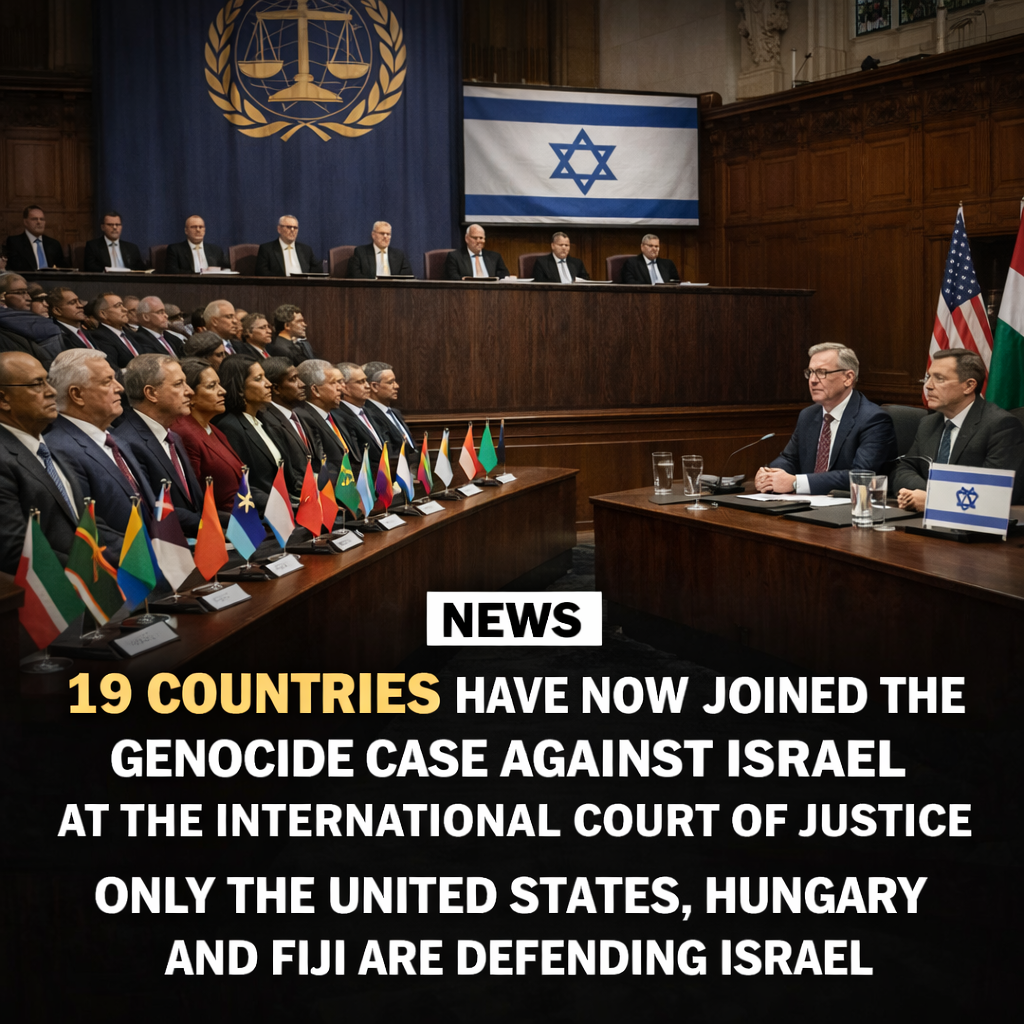
In December 2023, a significant legal case was brought before the International Court of Justice (ICJ), raising one of the most serious allegations under international law: whether Israel’s military actions in Gaza constitute genocide. The case was initiated by South Africa, which accused Israel of violating the Genocide Convention—a treaty that obligates states to prevent and punish acts intended to destroy, in whole or in part, a national, ethnic, racial, or religious group.
Since the filing, the case has drawn broad international attention and participation. Nineteen countries have formally submitted declarations supporting South Africa’s position. Among them are Netherlands, Iceland, Namibia, Colombia, Mexico, Spain, Turkey, Ireland, and Brazil. These countries have not become direct parties to the case but have exercised their right to intervene, offering legal arguments that may assist the court in interpreting the Genocide Convention.
On the other side, only three countries—United States, Hungary, and Fiji—have submitted declarations supporting Israel’s position. These interventions highlight a clear divide in how states interpret both the facts on the ground and the legal threshold required to establish genocide.
A central issue in the case is the concept of “genocidal intent,” which is a key requirement under the Genocide Convention. It is not enough to demonstrate large-scale destruction or civilian casualties; the law requires proof that actions were carried out with the specific intent to destroy a protected group. Several supporting countries have focused their arguments on this element. For example, the Netherlands has argued that policies such as forced displacement and restrictions on humanitarian aid could be considered indicators of such intent. Iceland has emphasized that attacks affecting children may be particularly relevant when assessing whether there is an intent to destroy a group, as children represent the future of that group.
In contrast, the United States has rejected the allegations, describing them as “false” and emphasizing that the legal standard for proving genocide is extremely high. U.S. officials have argued that intent must be clearly demonstrated and cannot be inferred solely from the scale of military operations or their consequences. This reflects a broader debate among legal scholars and governments about how the Genocide Convention should be interpreted in modern conflicts.
Germany’s position has also drawn attention. Initially, Germany indicated that it would intervene in support of Israel. However, it later withdrew from that plan after facing criticism and legal challenges alleging that its arms exports to Israel could make it complicit in violations of international law. This development underscores the wider implications of the case beyond the courtroom, as countries reassess their own policies in light of potential legal and ethical consequences.
While the ICJ has not yet reached a final decision, it has issued provisional measures. These are legally binding orders intended to prevent further harm while the case is under review. The court has instructed Israel to take steps to prevent acts that could fall under the Genocide Convention and to ensure the delivery of humanitarian aid into Gaza. However, there have been ongoing allegations that these orders have not been fully implemented, adding further complexity to the situation.
The case is expected to take several years to conclude, with a final ruling not anticipated before 2028. ICJ proceedings are typically lengthy, involving detailed written submissions, oral hearings, and careful deliberation by judges. Regardless of the outcome, the decision is likely to have far-reaching implications for international law, particularly in how genocide is defined and applied in contemporary conflicts.
Ultimately, this case represents a critical moment for the international legal system. It brings into focus not only the events in Gaza but also broader questions about accountability, the interpretation of international treaties, and the role of global institutions in addressing allegations of the gravest crimes.