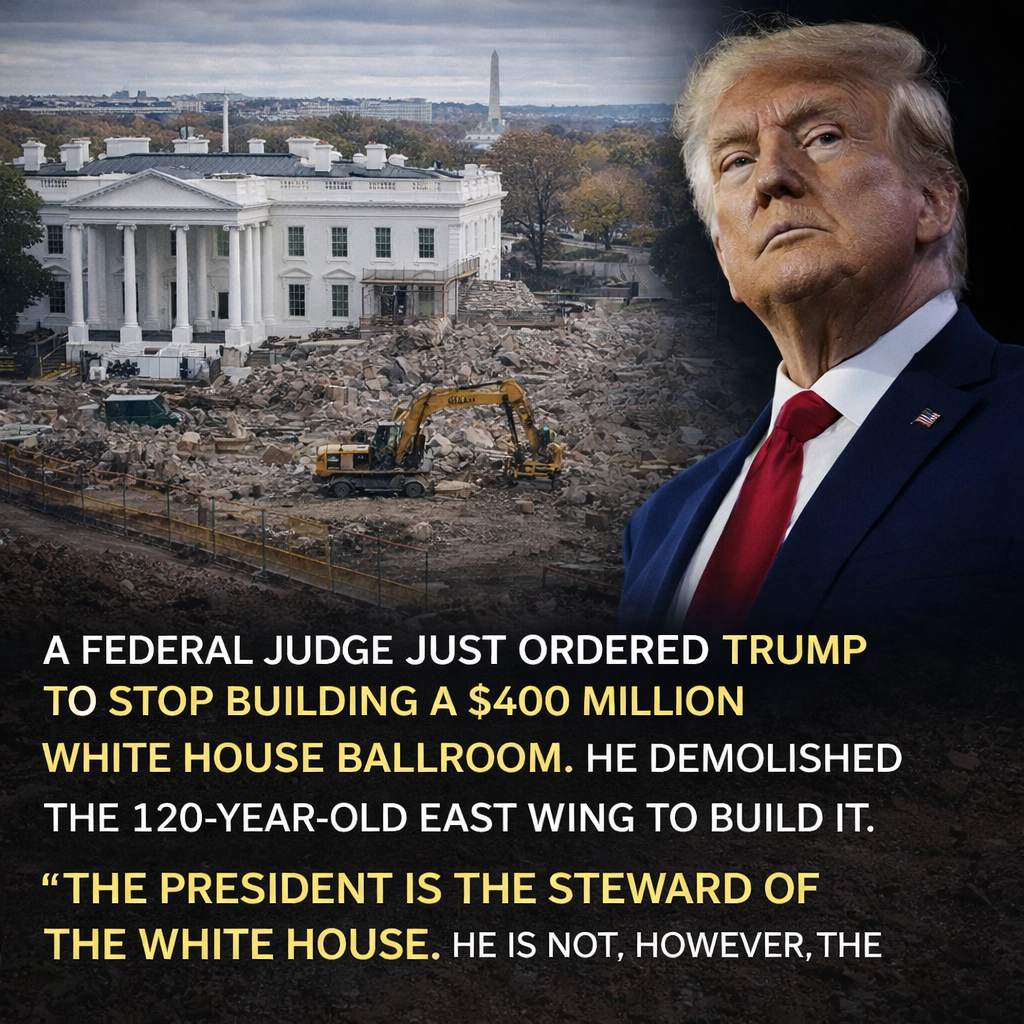
A controversial plan to construct a massive new ballroom at the White House has been temporarily halted following a federal court order, escalating tensions over presidential authority, historic preservation, and the role of private funding in government projects.
According to reports, former President Donald Trump initiated a $400 million project to build what would have been the largest ballroom ever associated with the White House. The proposed structure, spanning approximately 90,000 square feet and designed to host up to 999 guests, was intended to significantly expand the venue capacity for official events and state functions.
To make way for the project, the East Wing—an area with more than a century of historical significance—was reportedly demolished. The East Wing has traditionally housed offices for the First Lady and other administrative functions, and its removal raised immediate concerns among historians and preservation groups.
The project quickly drew legal scrutiny, culminating in a ruling by U.S. District Judge Richard Leon. In his decision, Leon stated that no existing statute grants a sitting president the authority to undertake such a large-scale construction project at the White House without explicit approval from Congress. Emphasizing constitutional limits, he noted that while the president serves as the steward of the White House, ownership ultimately belongs to the American people and is governed by law.
The judge’s order requires construction to be halted, with a 14-day window before enforcement takes full effect. In response, Trump filed an immediate appeal, setting the stage for a potential legal battle that could define the boundaries of executive power in matters involving federal property.
Another major point of contention surrounding the project is its funding structure. The ballroom was reportedly financed through private donations from major corporations, including companies that conduct business with the federal government. Judge Leon criticized this arrangement, referring to it as overly complex and raising concerns about transparency and potential conflicts of interest. Critics argue that allowing corporations with government ties to fund such a project could blur ethical lines and create perceptions of undue influence.
Despite these concerns, the proposal had received approval from a Trump-aligned Fine Arts Commission. However, public response was overwhelmingly negative. Reports indicate that more than 2,000 public comments were submitted during the review process, with approximately 99% opposing the construction. Many critics cited the destruction of historical architecture and questioned the necessity of such a large and costly addition.
The legal challenge was spearheaded by the National Trust for Historic Preservation, which filed a lawsuit in December. The organization argued that the project violated preservation laws and bypassed established procedures meant to protect historically significant sites. In response, Trump dismissed the group publicly, using harsh language and framing the opposition as politically motivated.
This case highlights a broader debate about how much authority a president holds over federally owned landmarks and whether modernization efforts should come at the expense of historical preservation. It also raises questions about the influence of private funding in public projects, particularly when donors have existing relationships with the government.
As the legal process continues, the future of the ballroom project remains uncertain. The outcome could set an important precedent, not only for the White House but for how executive power is exercised in managing national heritage sites.