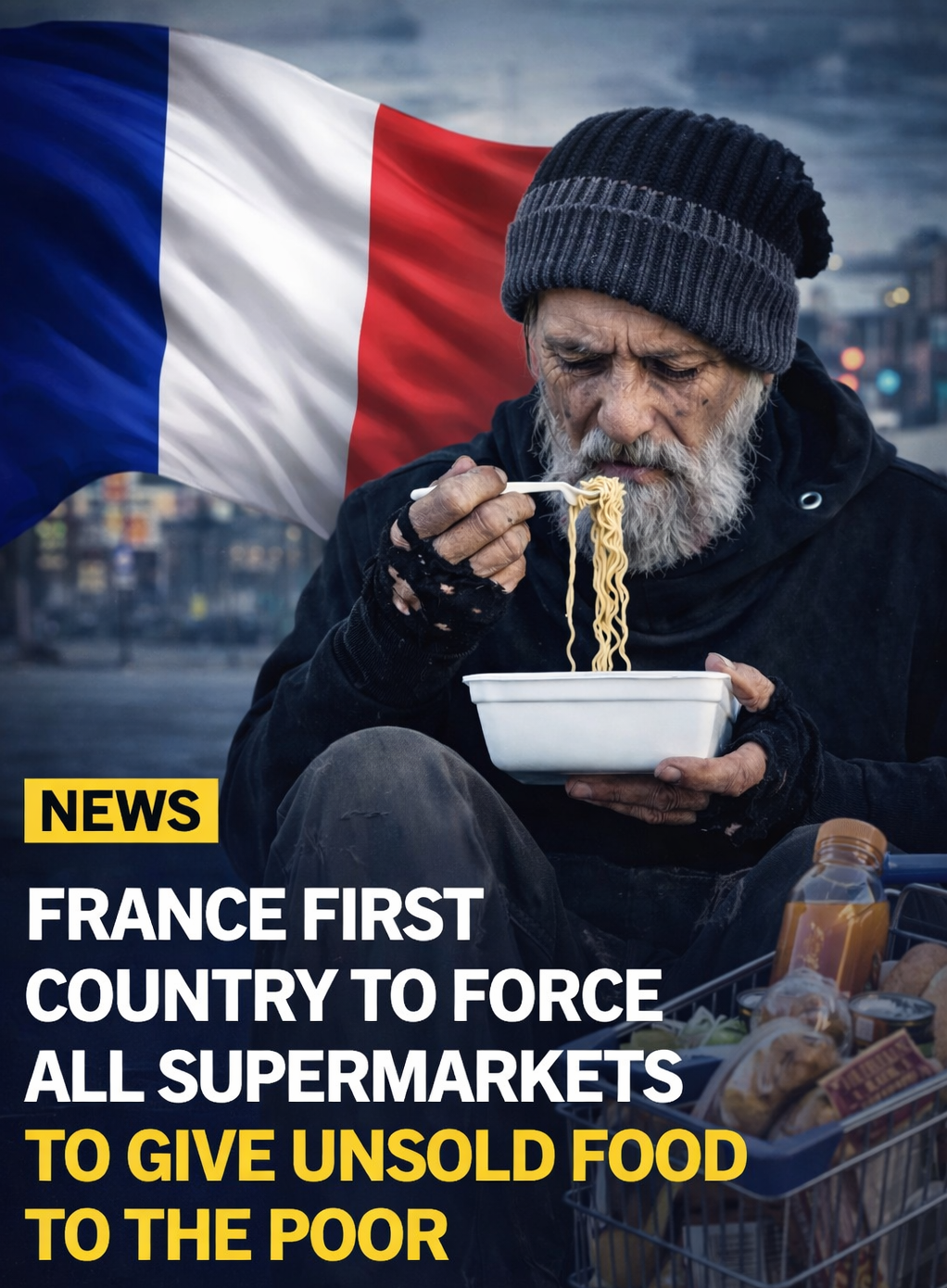
The Day France Decided Food Should Feed People, Not Landfills
Every night, behind the bright aisles of supermarkets, something strange used to happen. Perfectly good food—fresh bread, vegetables, yogurt, fruit—would quietly be thrown away.
Not because it was spoiled.
Not because it was unsafe.
But simply because it hadn’t sold.
At the same time, thousands of families across the country were struggling to afford meals. Food banks were running low, volunteers were trying to stretch donations, and many people were going to bed hungry.
The contradiction was impossible to ignore.
A Growing Problem
For years, activists and food charities in France spoke out about the massive amount of food waste. Millions of tons of edible food were being destroyed every year while people nearby couldn’t afford groceries.
Some supermarket chains even went to extreme lengths to prevent people from taking discarded food. Reports surfaced that certain stores poured bleach over thrown-away products to stop anyone from recovering them from dumpsters.
To many people, it felt not only wasteful—but deeply unfair.
Food banks began pushing for change. Environmental groups joined them, arguing that food waste also damages the planet by filling landfills and increasing greenhouse gas emissions.
The pressure kept growing.
The Law That Changed Everything
In 2016, France made history.
The government passed a groundbreaking law known as the Loi Garot, named after politician Guillaume Garot. The law introduced a simple but powerful rule:
Supermarkets larger than 400 square meters can no longer throw away edible unsold food.
Instead, they must donate it to charities and food banks.
If a store violates the law, it can face fines of up to €10,000 for each incident.
Suddenly, what used to end up in trash bins started arriving at community kitchens, shelters, and food distribution centers.
Perfectly good food finally began reaching the people who needed it most.
A New System of Cooperation
The law also encouraged supermarkets and charities to build partnerships.
Food banks began scheduling regular pickups from grocery stores. Volunteers sorted the donations, and the food was quickly redistributed to families, students, and elderly people struggling with food insecurity.
For many charities, the impact was immediate. Shelves that once sat half-empty were suddenly full again.
At the same time, supermarkets realized something surprising: donating food was actually easier—and often cheaper—than throwing it away.
A Global Inspiration
France’s bold move didn’t go unnoticed.
Other countries began watching closely. Inspired by the results, nations like Italy and the Czech Republic later introduced their own laws encouraging supermarkets to donate unsold food.
While their approaches differ, France remains the first country to make the practice mandatory.
More Than Just a Law
What France proved is that food waste isn’t just a logistical problem—it’s a moral one.
Every loaf of bread or box of vegetables thrown away represents resources, labor, and nourishment that could have helped someone.
By changing the rules, France turned what used to be waste into a lifeline for thousands of people.
And sometimes, solving a huge problem starts with a very simple idea:
Food should feed people—not landfills.