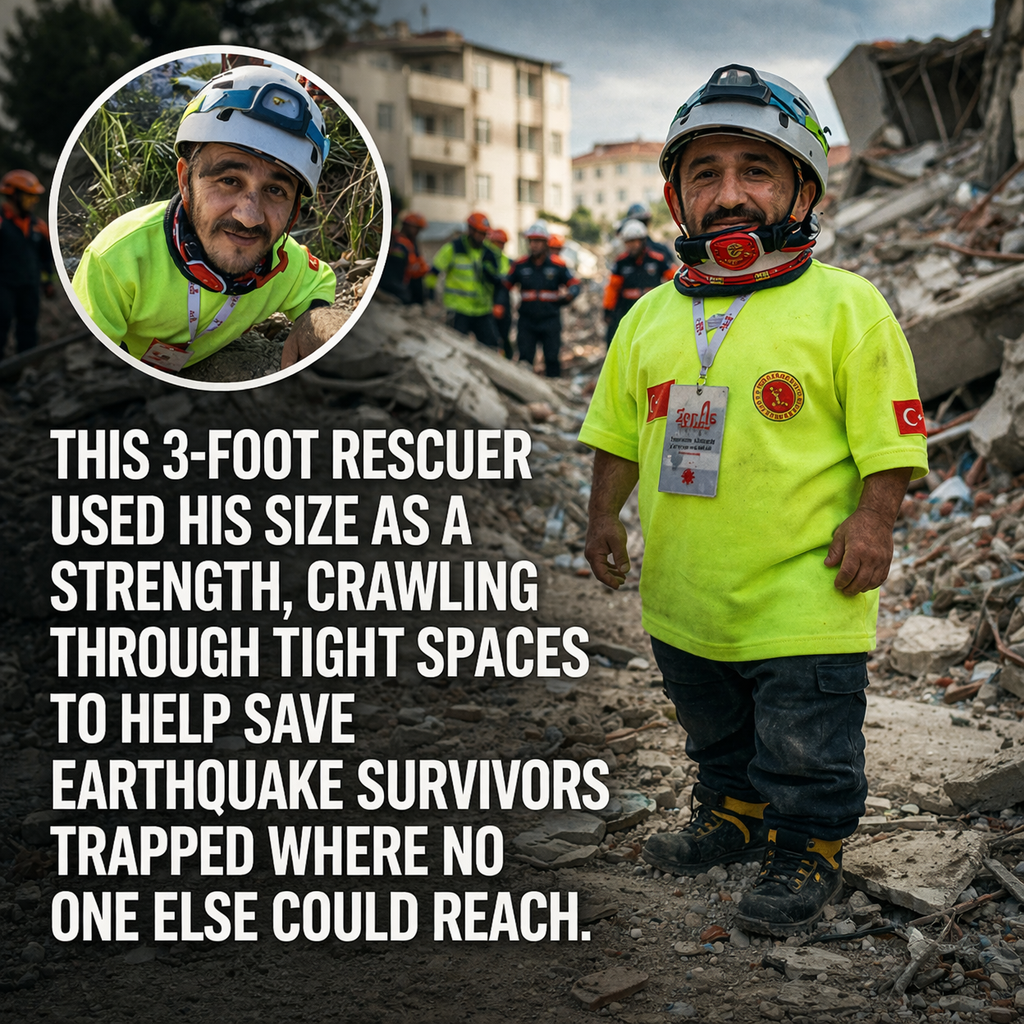
On October 30, 2020, a powerful magnitude 7.0 earthquake struck the Aegean Sea, sending shockwaves across western Turkey and the Greek islands. The city of Izmir was among the hardest hit, with buildings collapsing, families trapped under rubble, and emergency services racing against time. The disaster claimed 117 lives, injured over a thousand people, and left approximately 15,000 residents homeless.
Amid the chaos, stories of courage began to emerge—one of them centered on a man named Rıdvan Çelik. His story quickly spread across social media and news platforms, not just because of what he did, but because of who he was.
Çelik, who has dwarfism and stands around three feet tall, had spent much of his life navigating challenges that most people never face. Daily tasks could be harder, public spaces less accommodating, and physical limitations more noticeable. But during the earthquake rescue operations, those same traits became an unexpected advantage.
When Çelik arrived in Izmir to help, he realized that many of the collapsed structures had created extremely tight and dangerous spaces—areas that trained rescue workers, despite their expertise and equipment, struggled to access. Without hesitation, he volunteered to enter these narrow gaps.
Crawling through debris, broken concrete, and unstable structures, Çelik reached places that others simply could not. His efforts reportedly helped locate survivors trapped beneath the wreckage, guiding rescue teams to critical spots where time meant everything. In disaster situations, minutes can determine life or death, and his ability to navigate confined spaces made a real difference.
The emotional impact of his actions was just as powerful as the physical one. Çelik explained that his motivation was deeply personal—he saw himself in the victims. “It could have been me or my family under that rubble,” he said in interviews. This sense of shared vulnerability drove him to act, even when the risks were high.
Across Turkey, his story resonated strongly. Many people saw in him a powerful reminder that heroism does not depend on conventional strength or appearance. Instead, it can come from empathy, courage, and the willingness to step forward when it matters most.
Fact Check: What Is Verified and What Is Uncertain
The 2020 Aegean Sea earthquake is a well-documented disaster. Official figures confirm the magnitude, casualties, and widespread destruction in Izmir. Numerous verified reports and international coverage support these details.
However, the story of Rıdvan Çelik is less clearly documented in major global news outlets. While his story has circulated widely on social media and regional platforms, there is limited coverage from large, internationally recognized media organizations confirming every detail of his actions.
This does not necessarily mean the story is false—but it does suggest that some elements may be amplified or lack independent verification. Stories of individual heroism often spread quickly after disasters, and while many are true, they can sometimes become embellished over time.
The Bigger Truth Behind the Story
Whether every detail can be independently confirmed or not, the broader message remains meaningful. Disasters often reveal unexpected strengths in ordinary people. Individuals who might be overlooked in daily life can become essential in moments of crisis.
Çelik’s story highlights an important idea: what society often labels as a limitation can, in the right context, become a unique strength. His willingness to help, despite the risks, reflects a universal human instinct—to protect, to assist, and to stand with others in times of need.
In the end, the earthquake in Izmir was a tragedy that changed thousands of lives. But within that tragedy, stories like this remind us of something equally powerful—the capacity for courage that exists in all of us, waiting for the moment it is needed most.