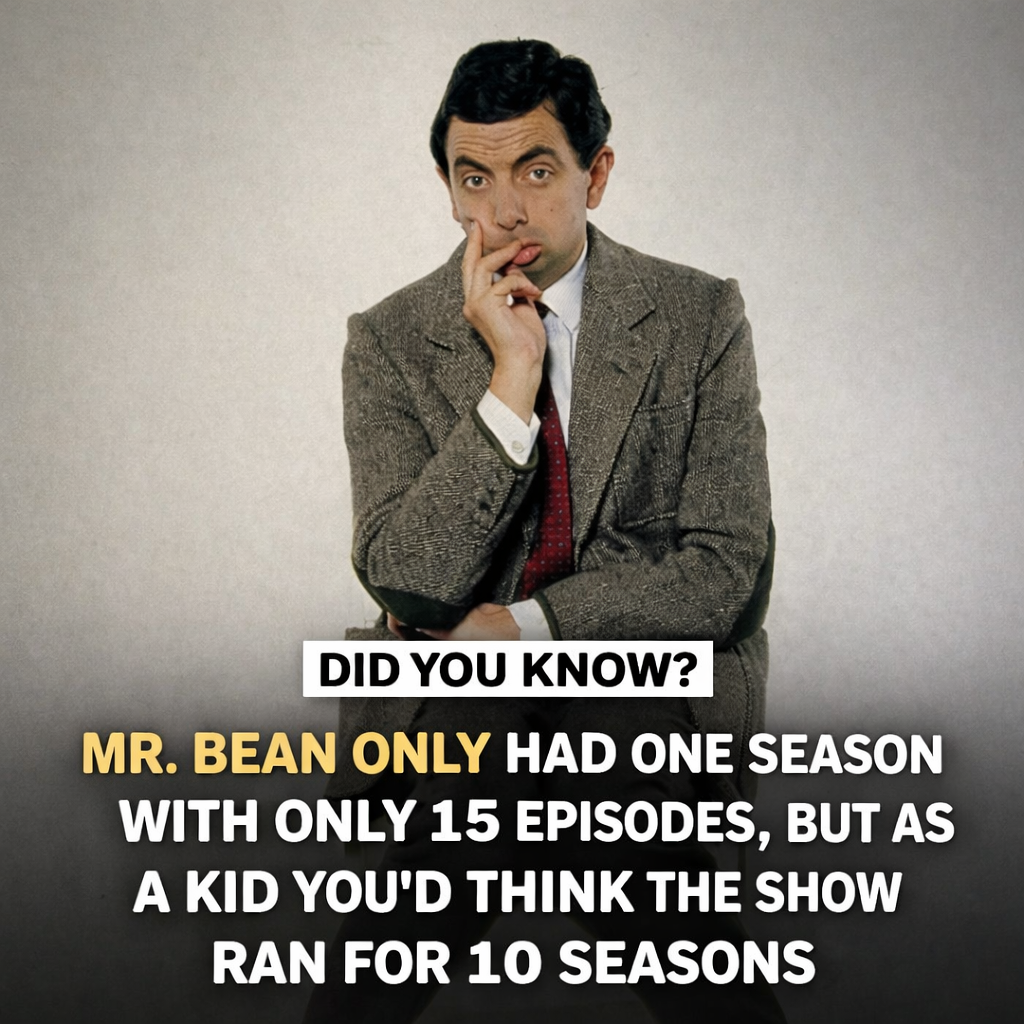
Many people who grew up watching Mr. Bean are often surprised to learn a simple fact: the original series consisted of just 15 episodes. Despite its massive global popularity and constant presence on television for decades, the show itself was remarkably short-lived in terms of original content.
The original run of Mr. Bean aired between 1990 and 1995. During those five years, only 15 half-hour episodes were produced. Unlike many long-running sitcoms that release dozens or even hundreds of episodes across multiple seasons, Mr. Bean did not follow that pattern. It did not have a traditional multi-season structure, and its episodes were released sporadically rather than in consistent yearly batches.
Yet, for millions of viewers worldwide, it feels as if there were far more episodes. This widespread perception is largely due to the way television networks handled the show after its release. Broadcasters across different countries repeatedly aired the same episodes, often cycling through them for years. Because the episodes were not heavily dependent on a continuous storyline, they could be shown in any order without confusing viewers. As a result, audiences were exposed to the same content multiple times, creating the illusion of a much larger catalogue.
Another key reason behind the show’s lasting appeal is its unique style of comedy. Mr. Bean relies heavily on physical humor and visual storytelling rather than dialogue. This approach made it universally accessible, as it required little to no translation. Viewers from different linguistic and cultural backgrounds could enjoy the humor equally. The character’s exaggerated expressions, awkward situations, and creative problem-solving resonated with audiences regardless of where they lived.
The central character, portrayed by Rowan Atkinson, played a major role in the show’s success. Atkinson’s performance as Mr. Bean combined elements of classic silent film comedy with modern situational humor. His ability to communicate emotions and humor without relying on words made the character instantly recognizable and widely loved. This style drew inspiration from earlier comedic traditions, including silent film legends, but adapted them for contemporary television audiences.
Despite the limited number of original episodes, the Mr. Bean franchise continued to grow. Two feature films were released: Bean (1997) and Mr. Bean’s Holiday (2007). These films expanded the character’s adventures beyond the television format and introduced him to new audiences around the world.
In addition, an animated version of the show, Mr. Bean The Animated Series, premiered in 2002. This series significantly increased the amount of Mr. Bean content available, producing over 130 episodes across multiple seasons. The animated format allowed for even more exaggerated scenarios and helped sustain the character’s popularity among younger generations.
The rise of the internet and digital platforms further amplified the show’s reach. Clips from the original episodes and films have been widely shared online, attracting millions of views. This constant rediscovery by new audiences has kept Mr. Bean relevant long after its original broadcast ended.
Ultimately, the enduring success of Mr. Bean demonstrates how a small body of work can have an enormous cultural impact. With just 15 episodes, the original series managed to achieve global recognition and lasting popularity. The combination of universal humor, a memorable character, and consistent rebroadcasting allowed it to transcend language barriers and generational gaps.
More than three decades later, Mr. Bean remains one of the most recognizable and beloved comedic characters in the world. Its legacy proves that quality and originality can outweigh quantity, and that even a limited series can leave a lasting mark on global entertainment.