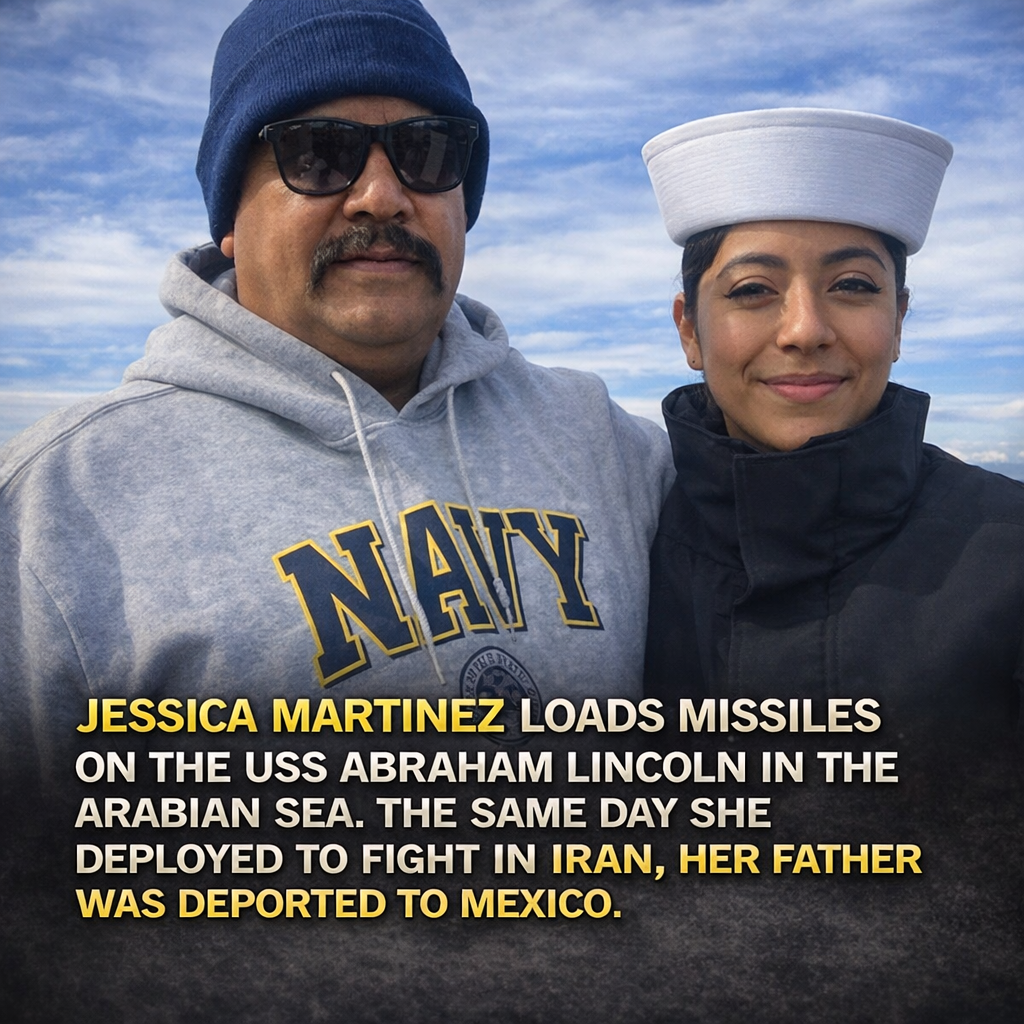
The case of the Martinez family highlights a deeply complex issue at the intersection of immigration enforcement, military service, and family unity in the United States. It raises a difficult question: should the law be applied uniformly in all cases, or should exceptions be considered when a family member is serving the country in uniform?
Jessica Martinez, a U.S. servicewoman, is currently deployed aboard the USS Abraham Lincoln, where she is involved in military operations in the Arabian Sea. Her role—loading missiles on an aircraft carrier—places her in a high-responsibility position within a critical national defense mission. At the same time she began her deployment, her father, Humberto Martinez, was deported to Tijuana, Mexico.
According to the Department of Homeland Security (DHS), Humberto was classified as a “criminal illegal alien.” Records indicate that he had been deported multiple times previously and had a conviction for driving under the influence (DUI). From a legal standpoint, these factors placed him squarely within the category of individuals prioritized for removal under U.S. immigration enforcement policies.
However, the timing and circumstances of the deportation have drawn attention. Humberto’s deportation occurred on the same day his daughter was sent overseas for military duty. His attorney described the action as “thoughtless,” arguing that the government failed to consider the broader human and familial context—particularly the fact that Jessica is actively serving the country.
From Tijuana, Humberto expressed a simple but emotional wish: to be able to reunite with his daughter when she returns from deployment. Meanwhile, Jessica’s sister, Ana, described the emotional toll on the family, saying they feel “torn apart.” Their situation reflects the reality faced by many mixed-status families in the United States—households where members have different immigration statuses, often leading to sudden and painful separations.
Legally, the case is relatively straightforward. U.S. immigration law does not generally provide immunity from deportation based on a family member’s military service. While there are certain discretionary programs—such as “parole in place”—that may allow undocumented family members of military personnel to remain in the country temporarily, these are not automatic protections and often depend on individual case reviews.
Supporters of strict enforcement argue that the law must be applied consistently. They point out that prior deportations and criminal convictions, even for non-violent offenses like DUI, are considered serious violations under immigration law. From this perspective, making exceptions could undermine the rule of law and create inconsistencies in enforcement.
On the other hand, critics argue that cases like this expose a gap between legal policy and moral judgment. They contend that deporting the parent of an active-duty service member—especially during deployment—can have unintended consequences, including emotional stress that may affect the service member’s well-being and focus. Some believe that military families, regardless of immigration status, deserve additional consideration due to their contribution to national security.
The Martinez family’s situation is not unique. Millions of families in the U.S. live with mixed immigration statuses, navigating a system where enforcement actions can occur suddenly and without regard to personal circumstances. Their story has become part of a broader debate about how immigration laws should be enforced—and whether compassion should play a larger role in decision-making.
Ultimately, this case does not offer easy answers. It underscores the tension between legal consistency and human impact, raising questions that policymakers, lawmakers, and society as a whole continue to grapple with.