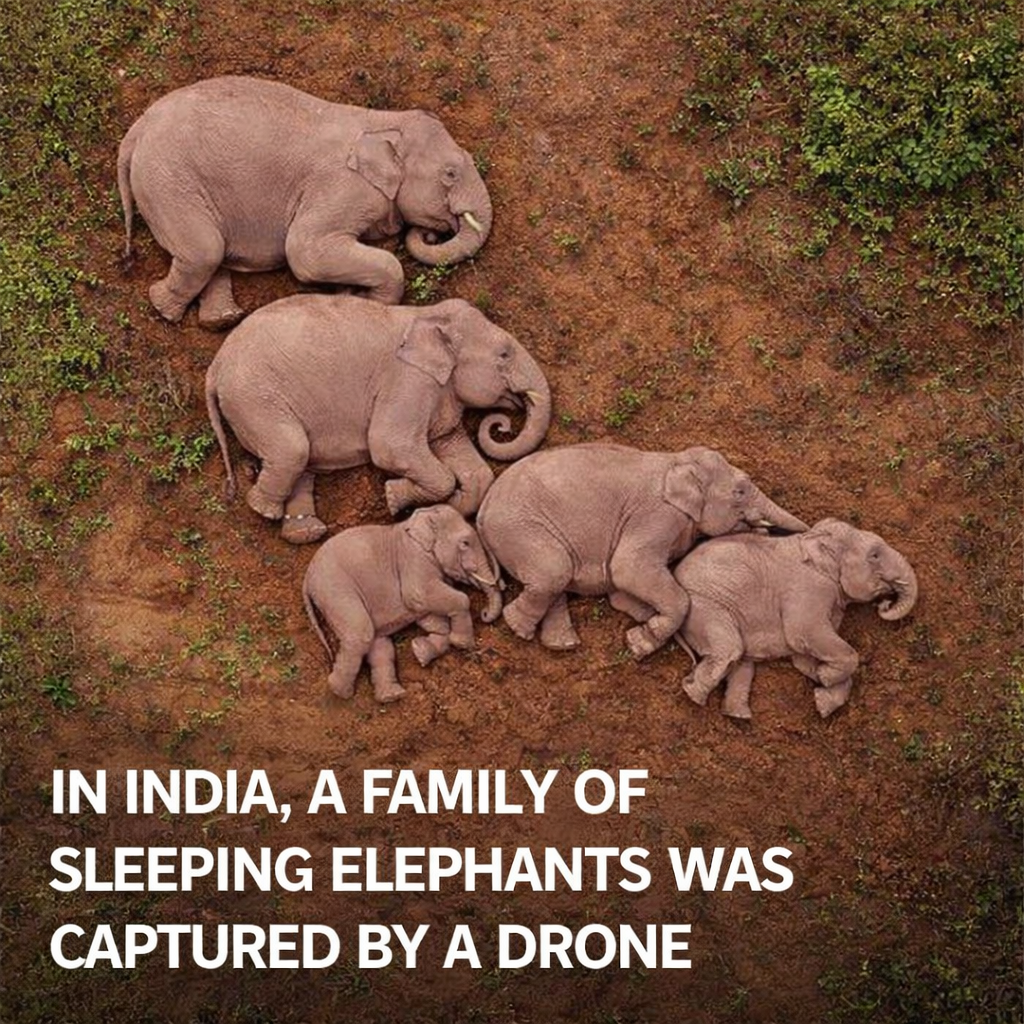
In the wild, moments of complete stillness are rare—especially among the largest land animals on Earth. Elephants, weighing up to five tons, are often seen as symbols of strength, intelligence, and resilience. Yet, a recent drone-captured image from a forest in India revealed a different side of these majestic creatures: vulnerability, trust, and deep social connection.
The image showed an entire elephant family lying down together, fast asleep. Adults and calves were huddled closely, some gently touching, others resting their trunks over one another. It was not just a beautiful visual—it was a scientifically significant moment. Elephants do not often sleep lying down, and when they do, it is usually for very short periods. To witness an entire herd in this position at the same time is extraordinarily rare.
Elephants are known to be among the lightest sleepers in the animal kingdom. On average, they sleep only two to four hours per day, and much of that rest happens while standing. This behavior is rooted in survival. In the wild, lying down makes them more vulnerable to predators and slower to react to danger. As a result, elephants have evolved to remain alert even during rest.
When elephants do lie down, it typically occurs during deeper sleep cycles, often referred to as REM (Rapid Eye Movement) sleep. This phase is essential for memory processing and overall brain function. However, entering this stage requires a strong sense of safety. For an entire herd to lie down simultaneously suggests a remarkable level of trust in their environment.
Elephant herds are matriarchal and highly social. They rely on strong bonds for survival, communication, and emotional well-being. The presence of calves in the sleeping group further highlights the importance of collective safety. Young elephants are especially vulnerable, and their protection depends on the vigilance of the herd. In most cases, at least one adult remains awake as a guard while others rest.
This makes the captured moment even more significant. It indicates a rare instance where the entire group felt secure enough to rest deeply without maintaining a lookout. Such behavior is not just about physical rest—it reflects the stability and health of the herd’s social structure and environment.
The use of drone technology played a crucial role in documenting this scene. Traditionally, observing wildlife at such close proximity without disturbance has been challenging. Drones allow researchers and photographers to capture natural behaviors from a distance, minimizing human impact. In this case, it provided a glimpse into a private moment that would otherwise remain unseen.
Beyond its scientific importance, the image resonated emotionally with millions of people worldwide. In a digital landscape often dominated by conflict and negativity, this quiet scene offered something different—peace, unity, and a reminder of the natural world’s gentler side. There was no dramatic narrative attached, no urgency or crisis. Just a family, resting together.
This moment also serves as a subtle reminder of the importance of conservation. Elephants face numerous threats, including habitat loss, human-wildlife conflict, and poaching. Scenes like this highlight what is at stake—not just the survival of a species, but the preservation of their complex social lives and behaviors.
Ultimately, the image captures more than sleeping animals. It tells a story of trust, safety, and connection. Even among the strongest creatures on Earth, there are moments of softness. And sometimes, those quiet moments speak louder than anything else.