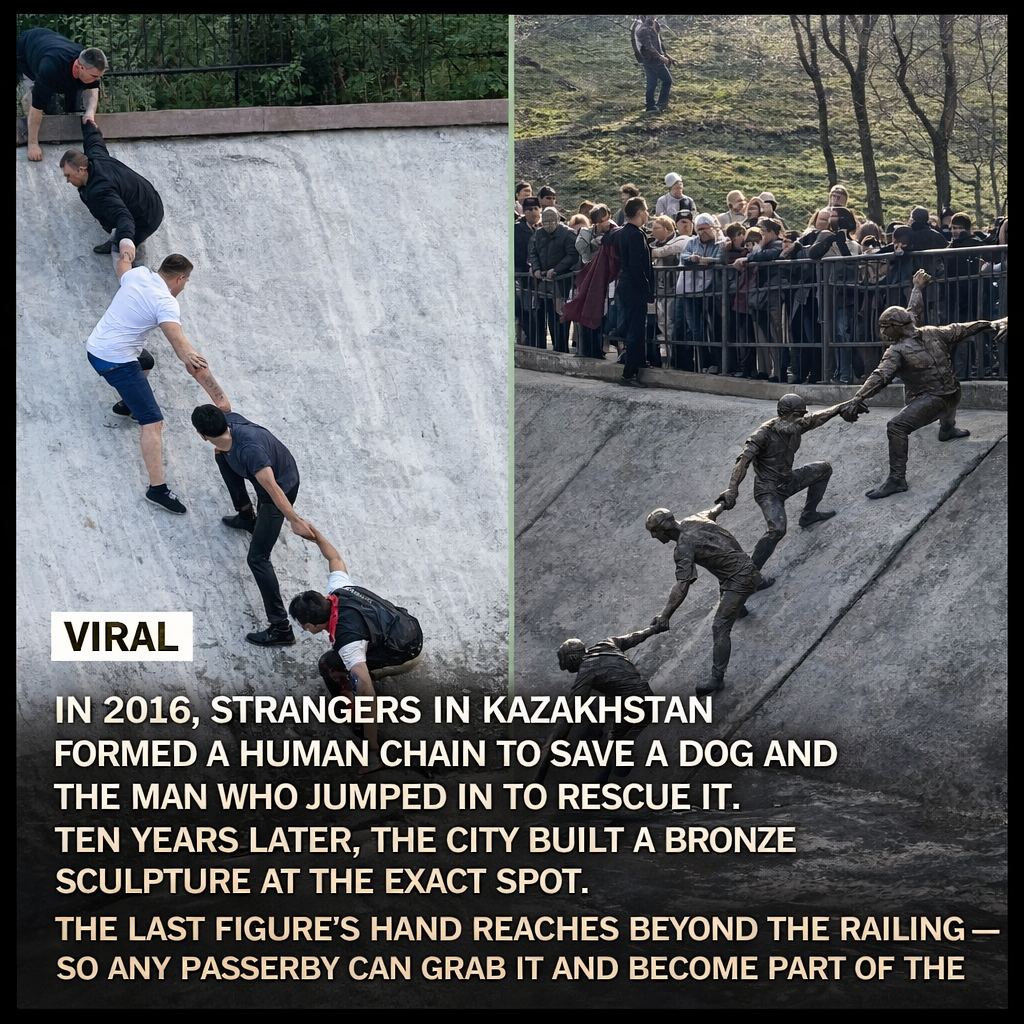
In a world often shaped by headlines of division and indifference, some moments quietly remind us what humanity looks like at its best. One such moment unfolded in 2016 in Almaty, when an ordinary day at the Sayran Reservoir turned into an extraordinary display of collective courage.
It began with a dog trapped inside the reservoir, unable to climb the steep concrete walls. A young man, moved by instinct and compassion, climbed down to rescue the animal. But once he reached the bottom, he found himself stuck as well. What could have ended in tragedy instead became something remarkable—because strangers chose not to walk away.
Without any planning, coordination, or instruction, people nearby began stepping forward. One by one, they linked arms, forming a human chain that stretched down toward the trapped pair. Each person relied on the strength and balance of the next. Together, they created a lifeline. Slowly and carefully, the chain held firm as they pulled both the man and the dog back to safety.
Someone captured the moment on video. Within hours, it began spreading across the internet. The footage eventually reached millions, including over 15 million views on the Facebook page of Daily Mail, along with countless shares across global platforms. Major international media outlets picked up the story, turning a spontaneous act of kindness into a worldwide symbol of unity.
What made this moment so powerful was not just the rescue itself, but how it happened. No one asked for recognition. No one waited for authority or direction. People simply saw a problem and responded together. It was a raw, unfiltered example of human instinct—to help, to connect, and to act.
A decade later, that same spirit was honored in a lasting way. On March 18, 2026, the city of Almaty unveiled a bronze sculpture at the exact location where the rescue took place. Positioned along the embankment near the Ulken River, the installation stands as both a tribute and a reminder.
Titled “Unity,” the sculpture was created by Yerbosyn Meldibekov, a renowned Kazakh artist whose work has been exhibited internationally, including in Antwerp, Hong Kong, and Singapore. The artwork captures the defining moment of the rescue: figures joined arm in arm, forming the same human chain that once saved two lives.
But what truly sets this monument apart is its interactive design. The final figure in the chain extends a hand outward, beyond the railing—inviting anyone passing by to reach out and join. It is a deliberate choice, transforming the sculpture from a static tribute into a living experience. Visitors are not just observers; they become part of the story.
The project, funded by private donors and approved by the city’s Department of Public Space Development, reflects a broader intention. It is not merely about commemorating a viral event, but about preserving a message. As city officials explained, the sculpture serves as a reminder of people who chose to act, who refused to ignore a moment of need.
In many ways, the story of Sayran Reservoir challenges a common narrative—that meaningful change requires organization, leadership, or grand planning. Instead, it shows that sometimes, all it takes is one person stepping forward—and another, and another—until something powerful takes shape.
Ten years on, the rescue is no longer just a video or a memory. It has become part of the city’s identity, embedded in bronze and shared with every passerby who pauses long enough to notice. The extended hand of the sculpture carries a quiet question: if the moment came again, would you step in too?
Because in the end, the story is not just about what happened in 2016. It is about what it represents—an enduring truth that even in a complex and divided world, people are still capable of coming together, without hesitation, to lift one another up.