The Silence Finally Broke
The first time my son came home with a broken arm, I knew before he said a word that something was terribly wrong.
He crossed the Montana parking lot slowly, one arm pressed against his chest. A bruise had already spread across his jaw, dark against his skin. He tried to act like he was fine, but I could hear the uneven catch in his breathing.
Someone had hurt my son.
And the man responsible for protecting our town was about to make sure nobody paid for it.
Sheriff Carl Gaines barely looked up when I brought Drew’s X-ray into his office. He leaned back in his chair, boots resting on his desk, as though my son’s broken bone were nothing more than an inconvenience.
“Kids fight,” he said casually. “Boys roughhouse.”
I stared at him.
“My son didn’t break his arm roughhousing.”
Gaines smiled, but there was no warmth in it.
“In this county, I decide how these things are handled.”
He waited for me to argue. He wanted anger. He wanted me to threaten him so he could turn the entire situation into a problem with me instead of what had happened to Drew.
I gave him neither.
I took my son home.
Then I opened my laptop.
I documented everything.
Every date. Every name. Every incident at school. Every teacher who suddenly became interested in looking at the floor. Every coach who told parents not to “make trouble.” Every hallway where Drew had been cornered. Every bruise, threat, and unexplained injury.
Then I started calling outside the county.
Helena. State offices. School authorities. Anyone whose job did not depend on Sheriff Gaines.
And then something unexpected happened.
Other parents began contacting me.
Quietly at first.
A conversation beside a garage.
A phone call after dark.
A whispered confession on a back porch.
Their stories were different, but the pattern was always the same.
Gaines’s son, Neil, had been protected for years.
His friends knew it.
The school knew it.
The sheriff knew it.
And everyone had been too afraid to challenge him.
Until now.
Three days later, state vehicles appeared on Main Street.
For the first time, Sheriff Carl Gaines wasn’t the most powerful man in town.
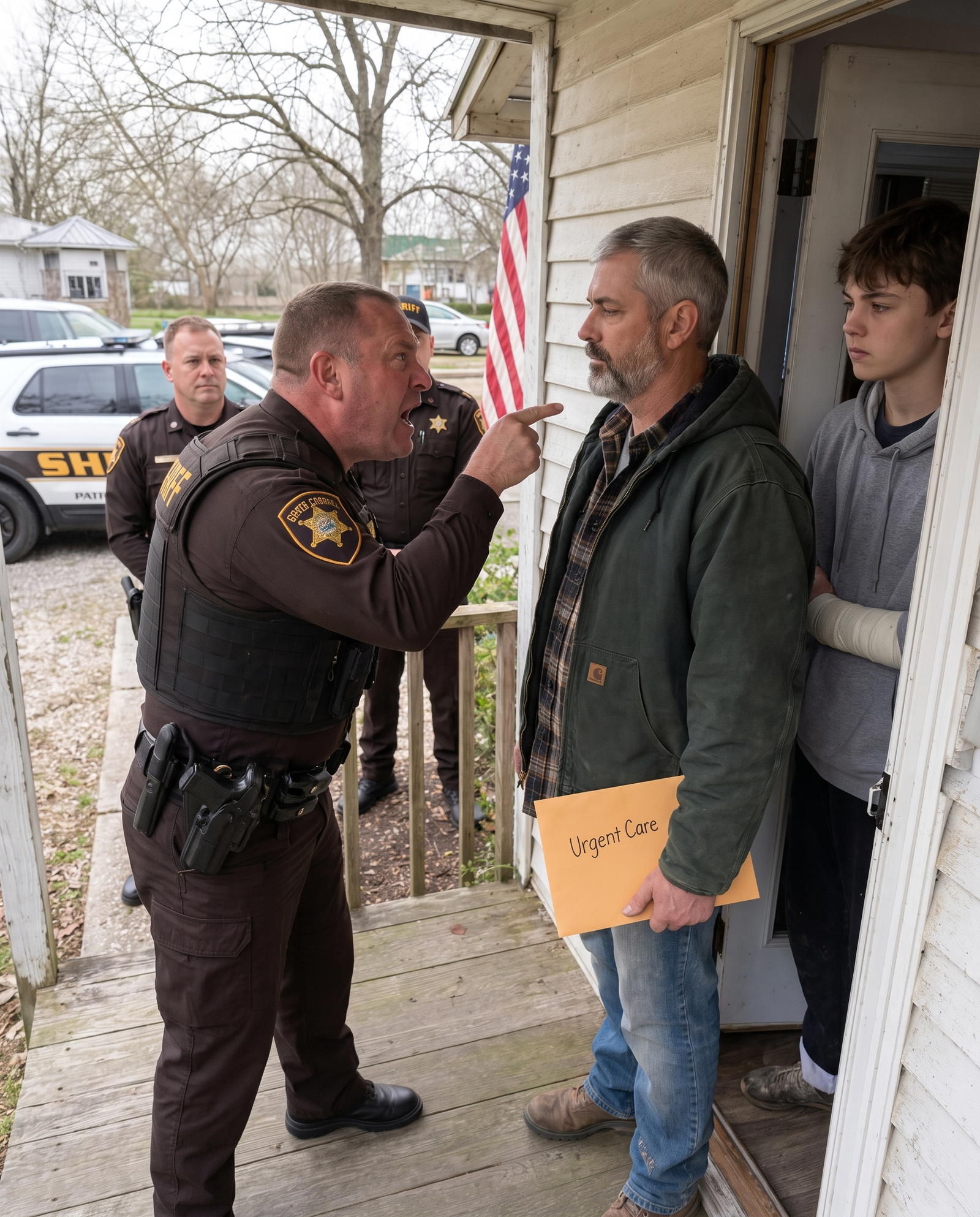
When he came to my house with three officers behind him, his face was red with fury.
“You did this,” he snapped, stepping toward my doorway.
The old version of me wanted to answer with force. Years ago, as a Ranger, I had learned exactly how quickly violence could end a confrontation.
But then I heard Drew behind me.
His breathing.
The careful movement of his injured arm.
The quiet way he had apologized for being hurt, as though any of this had been his fault.
I stepped outside and closed the door behind me.
“No,” I told Gaines. “You did this. I’m just making sure somebody finally takes responsibility.”
A state SUV stopped at the curb.
Deputy Parsons stepped out with two investigators and a thick folder.
It contained more names than just Drew’s.
Gaines’s expression changed.
The investigators had records, statements, dates, and evidence. Suddenly, the stories people had been too frightened to tell were no longer whispers.
They were evidence.
When Parsons ordered Gaines to step away from my house, he laughed nervously.
But it wasn’t the laugh of a powerful man anymore.
It was the laugh of someone realizing that the protection he’d counted on was disappearing.
The weeks that followed were not dramatic.
There were no movie-style arrests or heroic speeches.
There were hearings.
Documents.
Interviews.
Evidence.
And consequences.
Gaines lost his badge after investigators confirmed what he had allowed to happen—and how hard he had worked to keep it hidden.
Neil was transferred and eventually charged. Several of the boys who had followed his example were forced to face consequences for the harm they had caused.
Some families blamed us.
Others stopped speaking to us.
But some finally came forward.
Drew’s cast eventually came off.
His arm healed slowly.
What took longer was repairing the damage to his confidence.
Then, on the final day of school, he walked across the same parking lot where I had first seen him injured.
This time, his shoulders were straight.
His steps were steady.
He didn’t flinch.
When he reached me, he looked around the parking lot and said, “It’s different now.”
I looked at the school.
At the families.
At the town that had spent years pretending not to see what was happening.
“Yes,” I said. “It is.”
The town still had its silences.
But they no longer belonged to one sheriff.
They belonged to everyone who had finally decided to break them.