PART 1
The Blue Kettle had been open eleven years when my husband Ray died, and Marcus Reyes had been standing behind that counter with him for every single one of them.
Ray and Marcus met in culinary school in Louisville. They opened the diner together with a small business loan and a used flat-top grill they hauled in the back of Marcus’s truck. When Ray died of a heart attack in the walk-in cooler four years ago, restocking dairy at five in the morning, Marcus was the one who found him. He was also the one who sat with me on my porch steps for three hours that night, saying nothing, just staying.
So when the lawyer read Ray’s will and I found out he’d left his half of the diner to me outright, with Marcus staying on as co-owner and manager, I didn’t think twice. Marcus wasn’t just my husband’s business partner. He was my son’s godfather. He drove my mother to chemo appointments the two winters she needed it. He called me “sis” without a hint of irony.
For four years, the diner ran fine. Not great, but fine. Small towns don’t make anyone rich. Marcus handled the books because I’d never had a head for spreadsheets, and he’d always been better with vendors, always the one negotiating prices down at the farmer’s co-op.
“We had a slow month,” he’d say, sliding a folder across the desk in the back office. “Propane went up. We’ll make it back in the spring.”
I believed him every time.
Then, on a Tuesday afternoon in March, I walked into the storeroom to grab a case of coffee filters and heard Marcus’s voice on the other side of the shelving, low and fast, talking to Wendy Calloway, the accountant who did our quarterly filings.
“Just keep the Riverside Produce invoices separate from the rest,” he was saying. “Same account number as last time. Twenty-two hundred goes out Friday, same as February.”
“Diane’s going to ask about Riverside eventually,” Wendy said. “There’s no vendor by that name anywhere near here.”
“She won’t. She doesn’t read the ledger. She never has.”
I stood frozen behind a shelf of canned tomatoes, a case of coffee filters getting heavier in my arms.
“Just make sure the totals still land on ‘slow month,'” Marcus said. “That’s all she needs to see.”
PART 2
I didn’t say anything that day.
I put the coffee filters back exactly where I found them, walked out the side door, and sat in my car in the parking lot for twenty minutes before I could make my hands stop shaking enough to drive.
Riverside Produce.
I’d seen that name on invoices for at least two years and never once questioned it, because Marcus told me it was a co-op out near the county line that gave us a discount on greens. I’d never seen a truck. I’d never met a driver. I’d taken his word for it the way I took his word for everything, because that’s what family does.
Before Ray died, I’d spent six years as a bookkeeper for a construction firm in Bowling Green. It wasn’t glamorous work, but I knew how to read a general ledger, and I knew how invoices were supposed to tie back to bank statements. I’d simply stopped looking, because Marcus had asked me to trust him with it, and I had.
That night, after my son was asleep, I logged into the diner’s business bank account from my laptop, something I technically had access to but hadn’t touched in over a year.
I found six payments to “Riverside Produce LLC” going back eighteen months. Roughly two thousand dollars a month. No corresponding delivery receipts. No purchase orders. Just wire transfers, always initiated the same day the weekly deposit went in.
Twenty-two hundred dollars a month for eighteen months came out to just under forty thousand dollars.
I called Wendy Calloway the next morning and asked her, casually, if she could send me copies of the last two years of quarterly filings for my own records.
“Marcus usually handles that request,” she said.
“I know. I’m asking you.”
There was a pause. “I’ll have to check with him first.”
“Wendy,” I said. “I’m the majority owner of that business. You don’t need Marcus’s permission to send me our own financial records.”
She sent them within the hour. Every filing listed Riverside Produce as a vendor. Not one of them included an address, a phone number, or a tax ID that matched any registered business in the state.
PART 3
I hired an outside forensic accountant out of Nashville, a woman named Priya Shenoy who specialized in small business fraud, and I didn’t tell Marcus a single thing while she worked. It took her three weeks to trace the shell account back to a personal checking account belonging to Marcus’s brother-in-law, who ran a used car lot forty minutes away and had been struggling with debt for almost as long as the payments had been going out.
The diner’s twenty-fifth anniversary dinner had been planned for months before I found any of this. Marcus had insisted on inviting half the county, the mayor, two county commissioners, and every regular who’d eaten at that counter for two decades. He wanted a celebration. He wanted the town to see the Blue Kettle thriving.
I let him plan the whole thing.
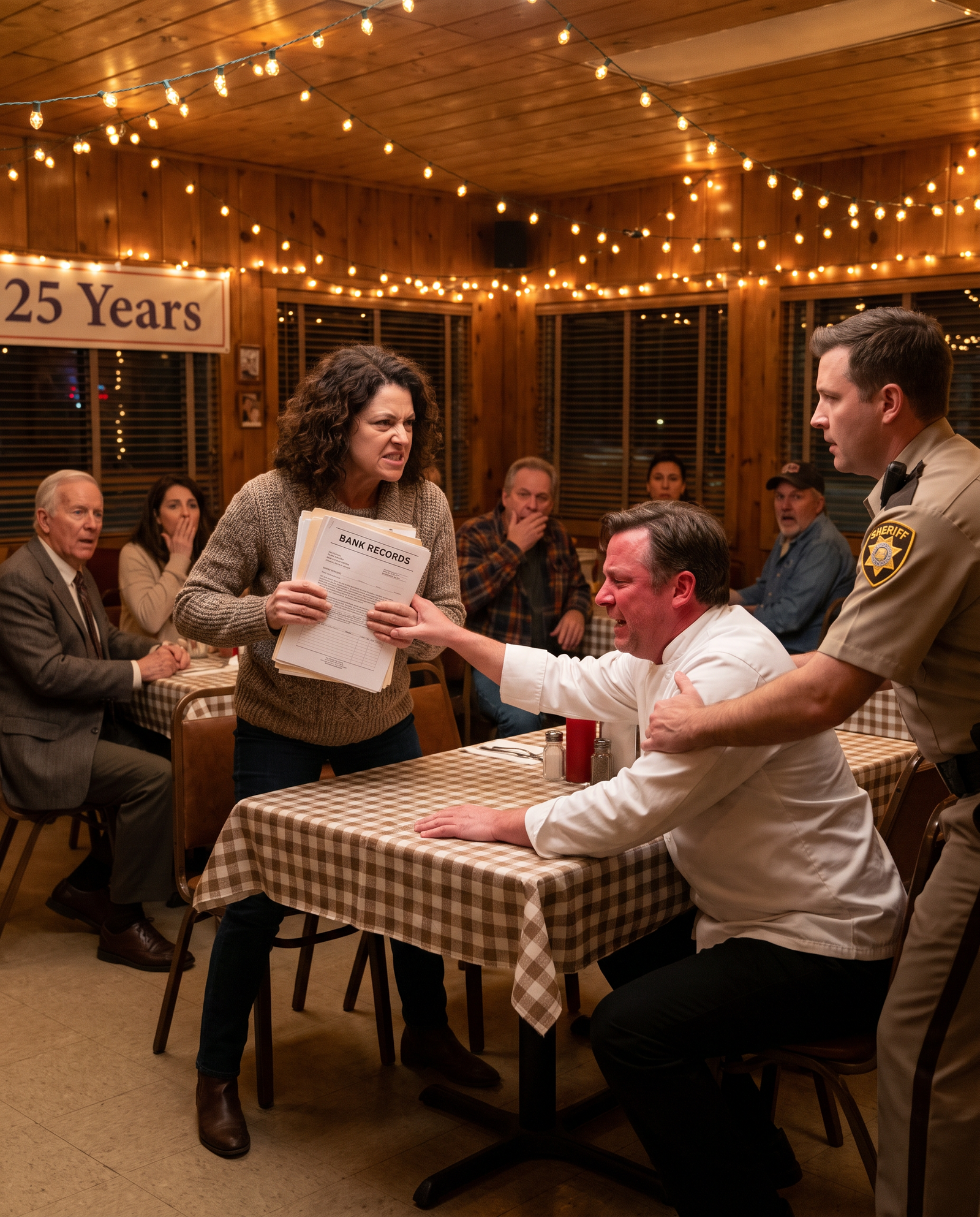
The dining room was packed that Friday night, string lights looped across the ceiling, the mayor standing at the podium mid-toast about “twenty-five years of Reyes and Foss serving this community,” when I stood up from the front table with the printed bank records in my hand.
“Before we go any further,” I said, “I think everyone should see something.”
Marcus’s smile didn’t move for a second, like it took his face a moment to catch up with what I’d said.
“Diane, now isn’t—”
“Riverside Produce doesn’t exist, Marcus.” I held the papers up so the mayor could see them, so the room could see them. “It never existed. For eighteen months, forty thousand dollars of this diner’s money went straight into your brother-in-law’s checking account.”
The room went dead silent except for the sound of somebody’s fork hitting a plate.
Marcus stood up and reached across the table, trying to grab the papers out of my hand. “You don’t understand what those numbers mean, you’re twisting—”
“I understand exactly what they mean.” I didn’t let go. “I heard you in the storeroom, Marcus. I heard you tell Wendy to keep it off my radar.”
Deputy Hal Prentiss, who’d been sitting two tables back enjoying his prime rib as a private citizen, was on his feet by then, gently but firmly getting between us.
“Mr. Reyes,” he said, “why don’t you sit back down.”
Marcus didn’t sit down. He tried to leave through the front, and Hal followed him out onto the sidewalk, where two more deputies were already waiting, because Priya’s forensic report had gone to the county prosecutor’s office four days earlier, and I’d known exactly what night I wanted this to happen.
RESOLUTION
Marcus was charged with felony theft by an employee and pleaded guilty eight months later rather than take it to trial. He was ordered to pay full restitution, just under forty thousand dollars, and received four years of probation along with a permanent ban from serving as an officer or manager of any Kentucky business.
Wendy Calloway lost her accounting license for a year for falsifying the filings, though she was never criminally charged, since she cooperated fully once investigators came calling.
I bought out what remained of Marcus’s ownership stake for a dollar, as part of the restitution agreement, and I run the Blue Kettle myself now with a manager I hired through an actual staffing agency and background check.
Two years later, the diner is doing better than it ever did under the old books. Turns out we were never actually having “slow months.” We were having Marcus months.
My son still calls Marcus his godfather out of habit sometimes, and I don’t correct him every time, because grief and betrayal don’t always travel at the same speed. But he doesn’t come to birthdays anymore. He doesn’t sit on my porch steps.
Family, I learned, isn’t a title someone earns once and keeps forever. It’s something you have to keep being worthy of, one ledger line at a time.