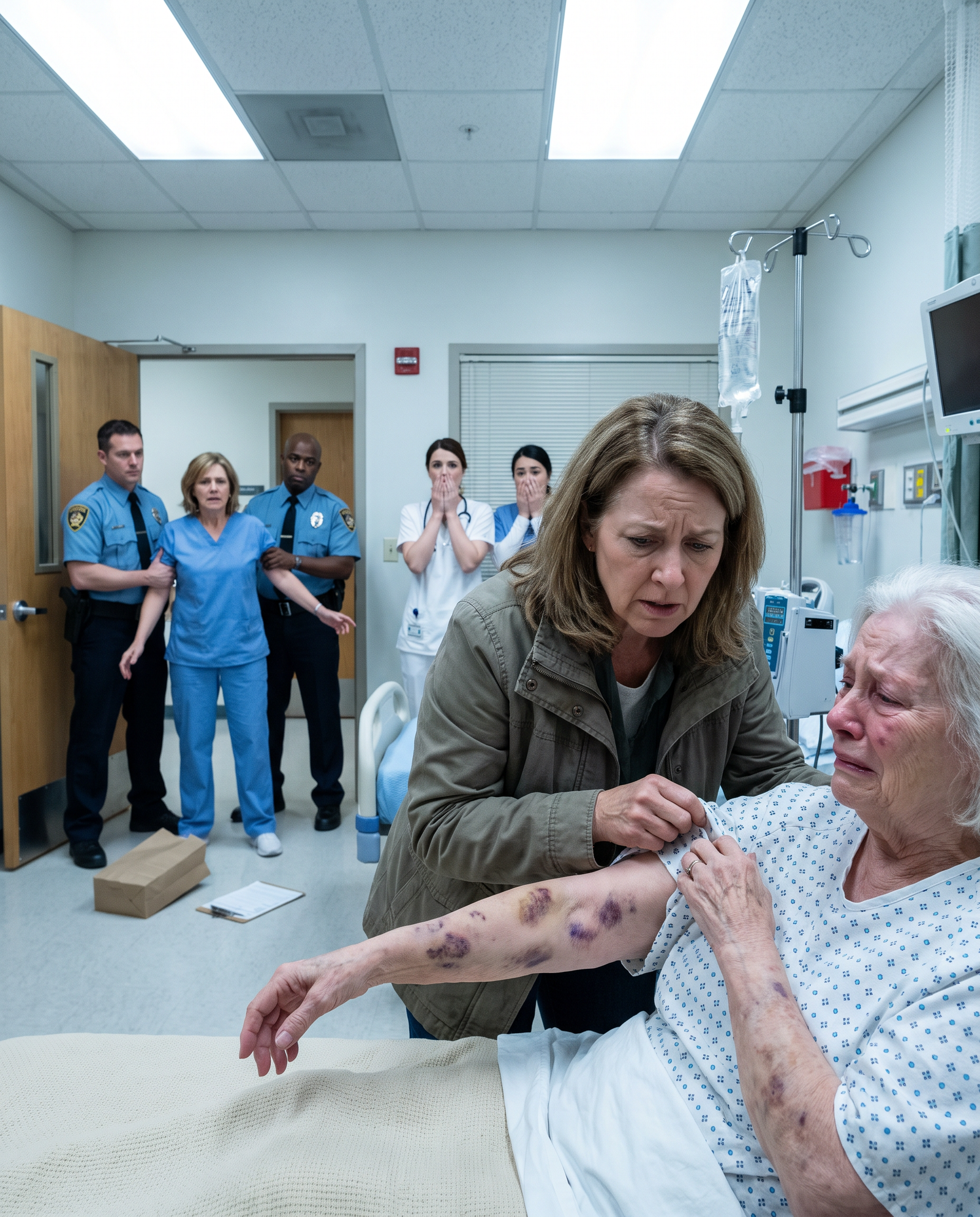
I pulled the blanket back at 6:40 on a Thursday morning, and the room got so quiet I could hear the IV pump ticking.
“Mom. Can you turn your arm for me?”
She wouldn’t. She kept it tucked against her ribs like a bird with something broken, and she looked past me at the door, checking it, the way you check a door when you know who’s coming through it.
My name is Delia Vance. I’m fifty-three, I’ve cut hair at the same shop on Delaware Avenue in Buffalo for twenty-six years, and I had spent the previous four months telling myself that the woman we hired to care for my mother was a blessing we didn’t deserve.
Her name was Sherry. She came through a private agency, she brought my mother lemon cookies, she remembered which nights were bingo nights at the senior center. She sent me photos. She wrote things in a spiral notebook like “good appetite today, ate the whole thing.” My mother had congestive heart failure and mild dementia and a stubbornness that outlasted both, and Sherry seemed to handle all three without ever once sounding tired about it.
Two days before that Thursday, my mother went into Buffalo General with what the ER called dehydration and a possible fall.
A possible fall. Those were the words on the intake sheet.
The first escape route closed on the first night, when I asked my mother what happened and she said, very clearly, “I don’t want to make trouble.” She said it the way she used to say it about my father, decades ago, and I hadn’t heard that particular flatness in her voice since I was in high school. I asked what kind of trouble. She said she was tired. She turned her face toward the window and that was the end of it.
The second closed the next afternoon. I asked the floor nurse about the marks I’d noticed on my mother’s forearm, four of them in a row, greenish-yellow, and the nurse looked for maybe three seconds and said, “That’s just how eighty-two-year-old skin behaves. They bruise from a doorframe. They bruise from us moving them.”
I wanted to believe her. I’d spent four months wanting to believe things.
“She has more on her back,” I said.
“Falls do that.”
The third escape route I closed myself, and I closed it out of cowardice. I decided I’d wait. I’d talk to Sherry calmly when she came in, ask a few reasonable questions, give her the benefit of the doubt she had earned with four months of lemon cookies and spiral notebooks. That’s what I told myself at eleven o’clock that Wednesday night, sitting in a vinyl chair, watching my mother sleep with her arm hidden.
Then at 6:40 Thursday morning, my mother woke up before I did, and she said my name, and when I reached over to help her sit up, she flinched away from my hand.
Not from pain. From the shape of a hand coming toward her.
So I pulled the blanket back, and I asked her to turn her arm, and when she wouldn’t, I did it myself.
I want to be careful about how I describe this, because I’ve replayed it about ten thousand times. Four oval bruises on the inside of her forearm, spaced the way fingers are spaced. One larger one on the opposite side where a thumb would sit. The bruise wasn’t a bruise from a doorframe. It was a grip. Somebody had held my mother’s arm hard enough to leave a record of their own hand on her, and then that record had aged for a week or more into that particular green-brown color.
I pushed her sleeve higher. There was another set above the elbow. Older. Purpling into brown at the edges.
That was when the room got quiet, because a nursing assistant had come in with the vitals cart and stopped in the doorway and was standing there holding a blood pressure cuff, looking at my mother’s arm, saying nothing.
“You see it,” I said.
“I need to get the charge nurse,” she said, and she left the cart in the room, which is how I knew she’d seen it too.
My mother started crying then, and she said the thing I will carry with me until I’m in a bed like that one myself.
“She said if I told you, you’d put me somewhere worse.”
Sherry arrived at 7:15 with a paper bag of the lemon cookies.
She’d been coming to the hospital every morning. I’d been grateful for it. She’d told me she wanted to keep my mother’s routine steady, and I’d thought that was the most thoughtful thing I’d heard in years, and standing there at 7:15 that Thursday I understood she’d been coming to make sure my mother didn’t say anything.
She walked in smiling. She saw the vitals cart abandoned in the middle of the room. She saw me holding my mother’s sleeve up. And she did the thing that ended any last shred of doubt I had.
She reached for my mother’s arm to pull the sleeve down.
I got between them. I’m not a big woman and I’ve never hit anyone in my life, but I put my body in that eighteen inches of space and I said, “Don’t you touch her.”
“Delia, she bruises so easily, you know this…”
“Whose hand is that?”
“That’s not a hand.”
“There are four fingers and a thumb, Sherry. Whose hand is that?”
The charge nurse came in behind her with the nursing assistant and a resident, and then a second nurse, and then the room had six adults in it and one eighty-two-year-old woman with her sleeve pushed up to the shoulder, and the collapse happened in front of every one of them.
Sherry said my mother was confused. She said dementia patients make things up. She said she’d been doing this work for eleven years and had never once had a complaint, and that if I wanted to accuse her of something I should be very careful, and she said all of it while backing toward the door.
The resident asked her to stay.
She said she had another client.
The charge nurse asked, quite politely, for her to remain until hospital security arrived, and Sherry turned and went for the hallway, and that is where two security officers stopped her about nine feet from the room. She pulled her arm away from the first one hard enough that a clipboard went across the floor and a visiting family down the hall came out of a room to see what the noise was.
My mother watched all of it from the bed. She had stopped crying. She was just watching, with an expression I’d never seen on her, like someone confirming something they’d been alone with for a long time.
The concrete consequences took eleven months to fully arrive, and they arrived anyway.
Adult Protective Services opened an investigation that morning. The hospital photographed everything, and the photographs mattered, because the bruise patterns were consistent with grip marks in three separate stages of healing, meaning three separate incidents at minimum.
The agency that placed Sherry pulled her from every client within forty-eight hours. There were nine of them. Two other families came forward within a month. One of them, a man in Cheektowaga whose father had died in February, had been keeping a notebook of his own.
The financial piece surfaced later and I hadn’t even been looking for it. My mother’s checking account had been drained of $18,400 over five months, in withdrawals of $200 and $400, the kind of amounts an eighty-two-year-old woman might plausibly take out and the kind she absolutely never did. Sherry had my mother’s debit card in her wallet the day security stopped her.
She pleaded to a felony count of endangering the welfare of an incompetent person, plus grand larceny in the fourth degree. Twenty-two months. She served fourteen. Restitution was ordered at $18,400, and my mother has received $2,150 of it.
The nurse who told me it was just how eighty-two-year-old skin behaves came and found me in the hallway two days after it happened. She didn’t make excuses. She said, “I looked for three seconds and I should have looked for thirty,” and then she went back to work, and I have thought about that sentence more often than I’ve thought about anything Sherry ever said.
It’s been two years.
My mother lives with me now, in the room that used to be my daughter’s, with a chair by the window because she likes to watch the street. She still has bad days. Her heart is worse than it was. She asks me sometimes, out of nowhere, whether Sherry is coming, and I say no, and she says okay, and we move on to something else.
Last Sunday I was doing her hair at the kitchen table, which I’ve done every Sunday since she moved in, and she was quiet for a long while under the comb.
Then she said, “You pulled my sleeve up in front of everybody.”
I said I did.
“I was so embarrassed,” she said. And then, after a pause long enough that I thought she’d drifted: “Thank God you did.”
I didn’t answer. I just kept working through her hair, section by section, the way I’ve done for strangers for twenty-six years, and outside the window a man was walking a dog he clearly could not control, and my mother laughed at him, and that was the whole afternoon.