The door came up on its track with that awful metal shriek storage units make, and the first thing my flashlight found was a crib.
Not a box. Not a tool chest. A white crib, assembled, with a mobile still hanging over it.
I said out loud, to nobody, in a unit off East Greg Street in Sparks at 9:20 on a Tuesday morning, “That’s not ours.”
My name is Marisol Ibarra. I’m thirty-eight, I’ve been a dental hygienist at the same practice in Reno for eleven years, and I had been married to Daniel for nine of them. We had one daughter, Camila, who was six. We had a mortgage we complained about and a dog with a bad hip and a standing Friday pizza night that we had not missed in three years.
I want you to understand that I was not a suspicious wife. I found the key by accident.
His truck had been making a noise, and he’d asked me to drop it at the shop on my way in, and when I pulled the floor mat up to shake out the gravel I found a small brass key taped to the underside with electrical tape. Not hidden in a glove box. Taped. Somebody only tapes a key under a floor mat when they’ve thought about it.
The tag on it said A&B Self Storage, unit 214.
The first escape route I closed was the reasonable one. I told myself it was work stuff. Daniel installed HVAC systems, he had equipment, contractors keep storage units all the time. So that night at dinner I asked him, casually, passing the rice, whether he’d ever thought about renting a storage unit for his gear.
He didn’t look up. He said, “Why would I do that? We have a garage.”
And Camila said something about a girl at school, and the conversation moved on, and I sat there with a fork in my hand and a key in my purse.
The second escape route closed the next morning. I called A&B Self Storage from the parking lot at work, and I said I was calling about the account for unit 214, and the woman on the phone said, “Sure, whose name is it under?”
“Ibarra.”
“I don’t have an Ibarra.” Papers moving. “Two-fourteen is under Ramos.”
Ramos was Daniel’s mother’s maiden name.
“Right,” I said. “That’s my husband’s mother’s name. How long has it been open?”
“Looks like four years in March.”
I said thank you and I sat in my car for eleven minutes and I did not cry, because I had a full schedule that day and a patient at 9:15 who was already in the chair.
The third escape route was the one I tried hardest to build. I decided I would just ask him. Directly. On Saturday, when Camila was at my sister’s. I planned the sentence out. I even practiced it: I found a key under your floor mat, and I called the storage place, and I want you to tell me yourself.
Then Tuesday came around, and Daniel said he had a job in Fernley and would be home late, and something in the way he said the word Tuesday made my whole body go cold.
The drawing taped to that crib said Daddy comes Tuesdays in green crayon.
Here is what was in unit 214.
A crib with a mobile of little felt elephants. A folded playpen. Three plastic bins of clothes, sorted by size, in the way people sort children’s clothes when they’re saving them for the next one. A car seat. A high chair with dried food still in the tray groove, which meant it had been used and put away by somebody in a hurry.
And on the far wall, a cheap corkboard with photographs pinned to it.
Daniel at a kitchen table I did not recognize, holding a baby. Daniel at a park, pushing a little boy on a swing. Daniel with his arm around a woman with dark hair, both of them squinting into the sun, and the woman was visibly pregnant, and the date printed in the corner of the photo was from two years ago.
Two years ago I had been pregnant too. We’d lost it at fourteen weeks. He’d taken a week off work and slept on the floor next to my side of the bed.
I stood in a metal box in Sparks with the sun coming in behind me and I understood that my husband had a second family, and that he had kept the physical evidence of it in a unit registered under his mother’s maiden name, and that he’d been visiting them on Tuesdays for years while I ran a Tuesday night bath for our daughter.
I took the drawing off the crib. I have it in a drawer right now.
Then I photographed every single thing in that unit, all forty-one photos, and I rolled the door back down, and I drove to the practice and I finished my shift, because I had four patients left and one of them was a twelve-year-old kid who was terrified of the ultrasonic scaler and had specifically asked for me.
The turn happened three days later, on a Friday, and it did not happen the way I planned.
I had planned to see a lawyer first. I had an appointment for the following Monday. But that Friday afternoon my sister called me and said Daniel had picked Camila up from school early, which was not the arrangement, and that he’d told the front office he was taking her to a family thing in Fernley.
Fernley. On a Friday.
I called him nine times. He didn’t answer. On the tenth he texted: Relax. Home by 7.
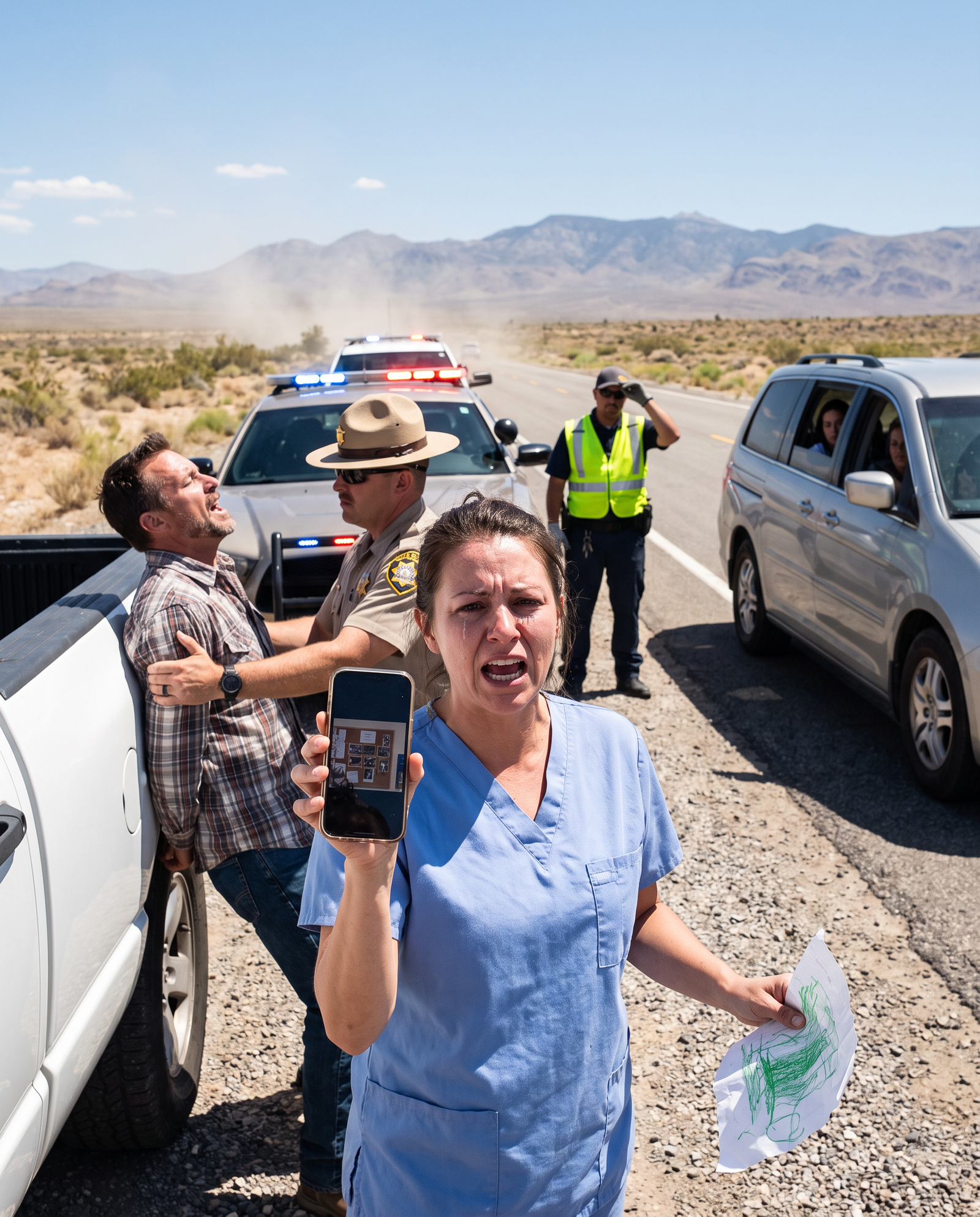
I got on I-80 East and I drove faster than I have ever driven in my life, and about eleven miles out I saw his truck pulled over on the shoulder behind a Nevada Highway Patrol cruiser with its lights going. He’d been stopped for speeding, which is the only genuinely lucky thing that happened to me that year.
I pulled in behind them. A trooper came toward my car with his hand up telling me to stay back, and I got out anyway with my phone in my hand.
“Ma’am, get back in your vehicle.”
“That’s my daughter in that truck,” I said. “That’s my six-year-old daughter and I need to see her right now.”
Camila’s face was already in the back window. She was fine. She waved at me. That’s the part that undid me, honestly, that she waved.
Daniel got out of the driver’s side. He said my name in that patient, put-upon voice, the one he used when he thought I was being dramatic in front of company.
“Marisol. What are you doing.”
I held up my phone with the photograph of the corkboard on the screen.
“Whose kids are these, Daniel?”
I want to tell you he denied it. He didn’t. He looked at the screen, and then he looked at the trooper, and then he looked at the ground, and what he said was:
“You went in the unit.”
“Whose kids are these?”
“You had no right to go in there.”
A second cruiser had pulled up by then. There were two troopers, a tow-truck driver who’d stopped behind us for reasons I still don’t understand, and a family in a minivan slowing down in the right lane with their windows open. That’s who was there. That’s the audience I got.
“Her name is Yesenia,” he said. “The boy is four. The baby’s eighteen months.”
“Eighteen months.”
“Marisol.”
“You slept on the floor next to me,” I said. “When we lost ours. You slept on the floor for six nights and she was pregnant.”
He reached for my arm.
He shouldn’t have done that. One of the troopers had him against the side of the truck in under two seconds, forearm across his upper back, saying sir, sir, hands where I can see them, and Daniel was still talking, still explaining, still saying my name in that voice while a state trooper held him against his own tailgate on the shoulder of I-80 with cars going by at eighty miles an hour.
The other trooper got Camila out of the back seat and walked her to my car with his hand on her shoulder, and she asked me if Daddy was in trouble, and I said we were going to go get dinner, which was not an answer, and she accepted it the way six-year-olds do.
Here’s what came out of it.
Daniel had been supporting the second household for four years. The forensic accountant my attorney hired found $214,000 routed out of our joint finances, most of it through a business account for a subcontracting LLC he’d registered in 2019 that did almost no actual subcontracting. A second mortgage he’d taken on our house without my signature turned out to be the thing that carried real legal weight, because the signature on it was mine and I had never seen the document. That’s forgery, and in Nevada that is a category D felony.
He took a plea. Eighteen months suspended, four years probation, restitution of $214,000 that he pays at $600 a month, which means I’ll be sixty-six when it’s finished.
The divorce took fourteen months. I got the house, which sounds better than it was, since it came with a second mortgage I spent two years fighting off.
Yesenia contacted me eight months in. I almost didn’t open the message. She hadn’t known about me either. He’d told her he traveled for work Wednesday through Sunday. She had a photo of him at a birthday party in a hat, and I had a photo of him at Camila’s birthday party in the same hat, eleven days apart.
We are not friends. I want to be honest about that. We are not two women who found sisterhood in the wreckage. But we text about the kids, because they’re siblings and they know it now, and twice a year they see each other at a park in Sparks that neither of us has any feelings about, which was the whole point of picking it.
It’s been three years this March.
I still have the crayon drawing in my nightstand drawer. Camila found it once, going through my things looking for tape, and she asked me what it was, and I told her it was a picture her brother drew a long time ago.
She thought about that for a second. Then she asked if she could keep it in her room instead.
I said yes. It’s taped to her wall now, next to a school photo and a drawing of the dog, at eye level for a nine-year-old, in a house that is finally, entirely, paid for by me.