The loan officer turned her monitor around so I could see it myself, and there was my name attached to four credit cards I had never once held in my hand.
“Mr. Okafor, I can’t approve this. Your debt-to-income is underwater. You’ve got sixty-one thousand in revolving balances across these accounts.”
“I have one credit card,” I said. “It has a nine hundred dollar limit and I pay it off every month.”
She looked at the screen, then back at me, with the careful face people make right before they tell you something that’s going to change your afternoon.
“These were all opened in the last three years. The most recent one was six weeks ago.”
My name is Emeka Okafor. I’m forty-four, I’ve driven a route for a regional freight company out of Columbus for sixteen years, and I had gone into that bank on a Tuesday to get pre-approved for a house. My wife and I had found a three-bedroom in Westerville with a yard our kids could actually run in. I’d saved for the down payment for six years, one automatic transfer at a time, and I was proud of that account the way you’re proud of a thing you built slowly.
I walked out of the bank without a pre-approval and with a printed credit report folded into quarters in my jacket pocket.
The first escape route closed in the parking lot. I told myself it was a mix-up. Another Emeka Okafor, a data error, a stolen number floating around after some corporate breach, the kind of thing that happens to everyone eventually. I sat in my truck and read down the report, and every account had my exact date of birth, my exact Social Security number, and a mailing address I didn’t recognize on the east side of the city.
I knew that address. I couldn’t place it for a second, and then I could. It was Darius’s old apartment. The one he’d lived in before he moved into the duplex.
Darius Bell. My best friend since we were both twenty-four, loading trucks on the same dock. Best man at my wedding. Godfather to my son. The man who’d sat with me in the hospital the whole night my father died and never once looked at his phone.
The second escape route closed that evening, and it closed hard, because Darius was in my house when it did.
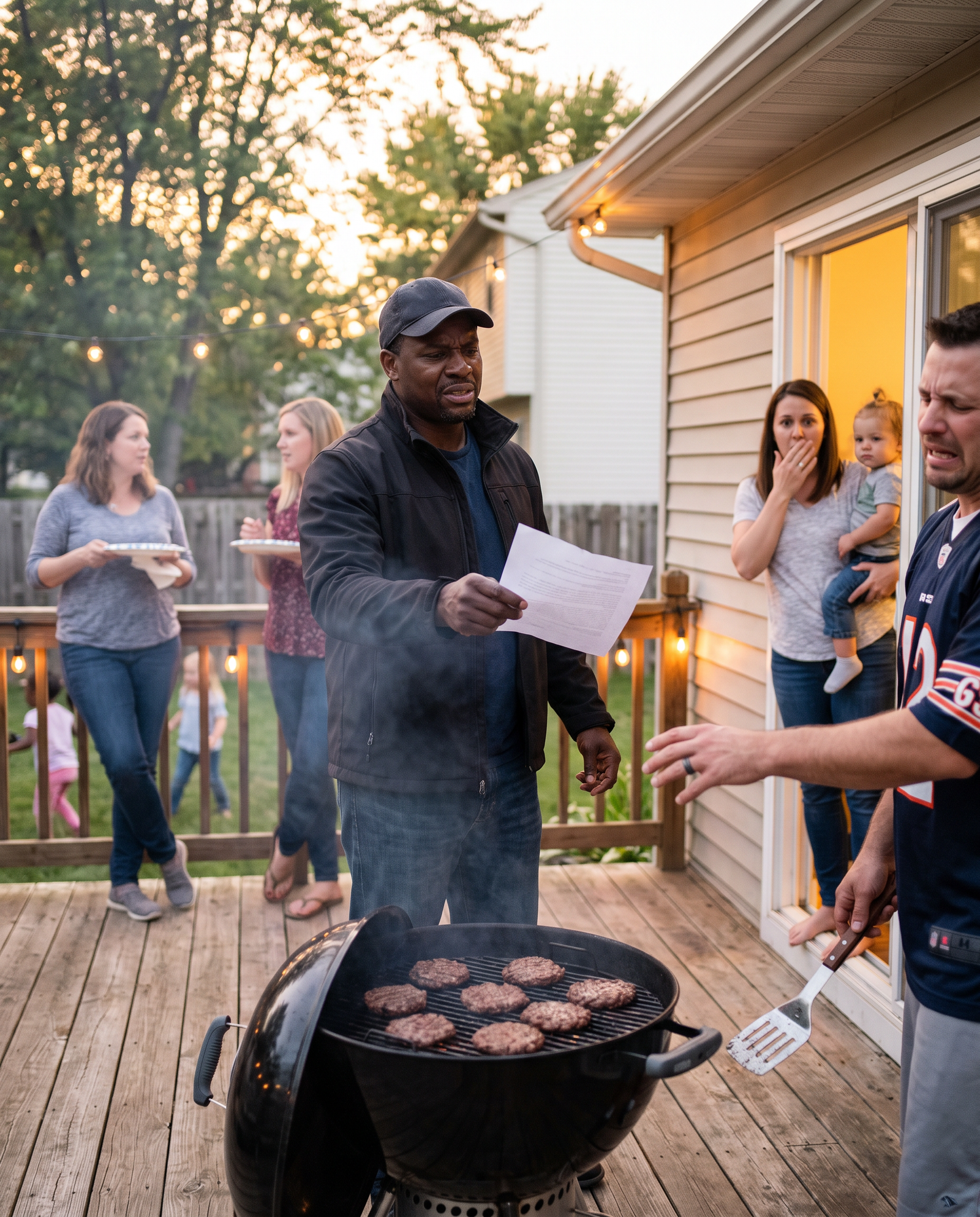
We had people over. It was a Tuesday but we did that sometimes, threw a few burgers on the deck, let the kids run around until it got dark. Darius was at the grill with a spatula, laughing at something my wife said, wearing a Browns jersey I’m pretty sure was originally mine.
I told myself I’d wait. I’d get the full picture first. I’d pull every document, confirm every account, maybe talk to a lawyer, and then I’d sit Darius down somewhere quiet and give him the chance to explain, because twenty years earns a man the chance to explain. That was the plan I made while watching him flip burgers on my own deck with my own spatula.
Then my daughter, who is nine, asked Darius why he got mail at our old mailbox, and the world tilted about four degrees.
“What mail, baby?” I said, keeping my voice light.
She shrugged. “Uncle Darius got a envelope out of the box last week when he picked me up. It had your name on it. I saw it said Daddy’s name.”
Darius didn’t turn around from the grill, but his shoulders changed. I’ve known that man for twenty years. I know the back of him. His shoulders went still in the exact way a person goes still when they’ve been caught and they’re deciding, in real time, whether to run.
That was the discovery beat, and it happened in front of eleven people holding paper plates.
I could have pulled him aside. I want to be honest that some part of me wanted to, even then, wanted to protect him from the thing that was about to happen to him in front of our friends. Instead I took the folded credit report out of my jacket, and I unfolded it, and I set it on the deck railing next to the grill.
“Darius. Whose address is this at the top?”
He looked at it for a long time. Longer than a guilty man usually gets, because everybody had gone quiet by then and nobody was going to fill the silence for him.
“Emeka, let’s talk inside.”
“Whose address is that.”
“It’s mine. It’s my old place. Let me explain it inside.”
“Sixty-one thousand dollars,” I said. “In my name. Cards I never opened. Mailed to your apartment. My daughter watched you take my mail out of my box.”
My wife had come to the sliding door. She had our youngest on her hip. She wasn’t saying anything, she was just looking at Darius the way you look at a stranger who’s suddenly standing in your kitchen.
Darius set the spatula down. And instead of denying it, instead of even trying, he did the thing that told me it was worse than I’d let myself believe. He said, “I was going to pay it back. All of it. I’ve been paying the minimums; you were never going to feel it, I just needed the room for a while.”
“A while,” I said. “Three years.”
“I got behind. After the thing with Renee, the custody stuff, the lawyer took everything I had. I couldn’t get approved for anything. My own credit was gone.” He was talking faster now, and every sentence made it worse. “You had good credit and you never checked it. I knew you never checked it. I was going to have it cleared before you ever needed it.”
“I needed it today,” I said. “I went to buy my kids a house today.”
That landed on him. I watched it land. He opened his mouth and nothing came out, and one of our friends, a woman named Patrice who’d known us both for years, said, very quietly, “Darius. What did you do.”
The collapse happened right there on the deck, in front of everyone who mattered to both of us. Nobody yelled. That’s the part I didn’t expect. It was very quiet, and quiet was so much worse. People started gathering their kids. Patrice’s husband put his burger down unfinished on the railing and just left it there, and that unfinished burger is somehow the thing I remember most clearly.
Darius left before it got fully dark. He tried to say something to me at the door, my name mostly, and I couldn’t look at him, and he went.
The concrete consequences took about ten months to fully arrive.
I filed a police report, which I did not want to do and did anyway, sitting at my kitchen table at two in the morning after my wife told me that protecting him one more time would cost us the house and maybe more than the house. The detective walked me through it. What Darius had done had a name. It was identity theft and it was bank fraud, and because the total crossed a threshold and involved federally insured institutions, it wasn’t a small thing.
He’d opened seven accounts in total, not four. The bank had only flagged the four that were active. The full amount was closer to seventy-eight thousand dollars. He’d used my information to lease a car eighteen months earlier, a car I’d seen him drive, a car I’d complimented him on in the parking lot of a Wendy’s without knowing I was technically the one paying for it.
He took a plea. Federal charges. Twenty-seven months, and an order of restitution I will probably never see completed, because you cannot get blood from a man who committed the crime specifically because he had no blood to give.
The identity recovery took the better part of a year. I filed affidavits, froze my credit, disputed every account line by line, and sat on hold with fraud departments for more combined hours than I want to add up. We got the house eventually, eleven months later than we’d planned, a smaller one, on a different street, with a yard that turned out to be even better than the first.
It’s been two years now.
Darius wrote me a letter from the facility about eight months in. Four pages. I read one and a half of them and put it in a drawer. He didn’t make excuses in it, to his credit, but I’ve learned that a man not making excuses after he’s already been caught isn’t the same as a man being honest, and I couldn’t tell yet which one this was, so I stopped reading.
My son asked about him last month. He’s eleven now. He asked, out of nowhere at dinner, whether Uncle Darius was ever coming back, and my wife and I did that thing married people do where you have an entire conversation with your eyes in half a second.
“He made some bad choices,” I told him. “Choices that hurt our family. And he has to answer for those.”
My son thought about it. Then he asked if a person could do a really bad thing and still be a good person underneath, and I told him the truth, which was that I didn’t know, and that I’d been trying to figure out that exact question for two years and hadn’t landed on an answer.
He seemed okay with that. Kids are more okay with “I don’t know” than adults ever are.
Last week I finally took the second and third pages of that letter out of the drawer and read them. I’m not going to tell you what they said. I’ll only say that I haven’t decided anything, and that for the first time in two years I put the pages back without my hands shaking, which I’m choosing to count as its own small kind of progress.