PART 1
The man in the flannel jacket was holding out a water-damaged photo album, and I was three seconds away from telling him I wasn’t interested when I saw the handwriting on the inside cover.
“Ma’am, you bought 214, right?” He shifted his weight, uncomfortable. “This fell out of one of the boxes when they were loading. I didn’t want to just leave it in the dirt.”
I took it. The cover was cheap vinyl, the kind you buy at a drugstore, and the first page had a strip of masking tape running across the top with four words written in blue ballpoint.
Ellis family — Tacoma, 2016.
That was my father’s handwriting. The looping capital E, the way he crossed his T’s too low. I’d been looking at that handwriting on birthday cards and permission slips my whole life.
My father died in 2007.
I know he died in 2007 because I was nineteen years old, sitting in a folding chair at Grace Fellowship in Spokane, watching a closed casket that my mother told me had to stay closed because of the accident.
I looked up at the man in the flannel jacket.
“Where did you say this came from?”
“Unit 214. The one you just bought for two hundred and ten.” He pointed toward the row of open roll-up doors behind him, where an auctioneer was already moving the crowd toward the next locker. “There’s more in there. Whole boxes of it.”
I’d only come to the auction because my friend Dee ran an antique booth and had begged me to keep her company on a Saturday. I bid on 214 because it was cheap and because I’d had two coffees and it seemed funny at the time.
I walked back to the open unit with the album under my arm and my ears ringing.
Inside were eleven cardboard boxes, a bicycle with flat tires, and a green plastic tote with a broken latch.
The top box was labeled, in the same blue ballpoint, Christmas.
PART 2
I sat on the concrete floor of that storage unit for almost two hours.
Dee found me there and sat down without asking any questions, which is the entire reason we’ve been friends for fifteen years.
The albums went from 2009 to 2019. Ten years of a family I had never seen before in my life. A woman with dark hair pulled back in a clip. Two kids, a boy and a girl, aging across the pages the way kids do in photo albums, gap teeth to braces to graduation gowns.
And in almost every picture, standing off to one side with his hand on someone’s shoulder, was my father.
Older. Grayer. Thinner in the face. But him.
“Nina,” Dee said quietly. “Are you sure?”
I turned the album toward her and pointed at his left hand. There’s a scar that runs across the back of it, a curved white line from a table saw accident in 1994 that I remember because I was six and I rode to the emergency room in the back seat with a dish towel wrapped around his fingers.
The scar was in the photos. Every one of them.
“He was fifty-two when he died,” I said. “In these he’s got to be sixty-five.”
Dee didn’t say anything for a while. Then she said the thing I was already circling and couldn’t make myself land on.
“Who identified the body?”
I called my mother from the parking lot. She picked up on the fourth ring, and I could hear her television in the background, some home renovation show she watches on a loop.
“Mom, who identified Dad?”
There was a pause long enough that I heard the show go to commercial.
“Why are you asking me that?”
“Just answer it.”
“The medical examiner handled everything, honey. That’s why the casket was closed. I told you that.”
“Did you see him?”
Another pause.
“Nina.”
“Did you see him, Mom?”
“I’m not doing this over the phone.”
She hung up.
I stood in a gravel lot in front of eleven boxes of another family’s Christmas mornings, and I understood that my mother had just answered my question completely.
PART 3
The lease on unit 214 was in the name Robert Ellis. The facility manager wouldn’t tell me anything else, but he didn’t have to, because the boxes did.
Inside the green tote were tax documents, a Washington State driver’s license expired in 2021, and a stack of mail. The driver’s license had my father’s face on it, my father’s scar visible on the hand resting on the counter in the background of the photo, and a date of birth eleven months off from the one on the death certificate framed in my mother’s hallway.
There was also a bundle of letters, rubber-banded, addressed to a P.O. box in Tacoma.
Thirty-one of them were from my mother.
I read four before I had to stop and walk around the block.
She’d known. Not later, not eventually. From the beginning. The letters started in 2008, the year after the funeral, and they were logistical, almost bored. Money he owed. When she’d deposit things. A note in 2011 that said, the girls still ask about you at Thanksgiving, I keep telling them the same story so keep yours straight if anyone ever finds you.
The girls. Me and my sister Bree, who was fifteen when we buried an empty box.
I didn’t confront my mother alone, and I didn’t do it in her living room where she could turn the television up and wait me out.
I did it at my niece’s baptism.
PART 4
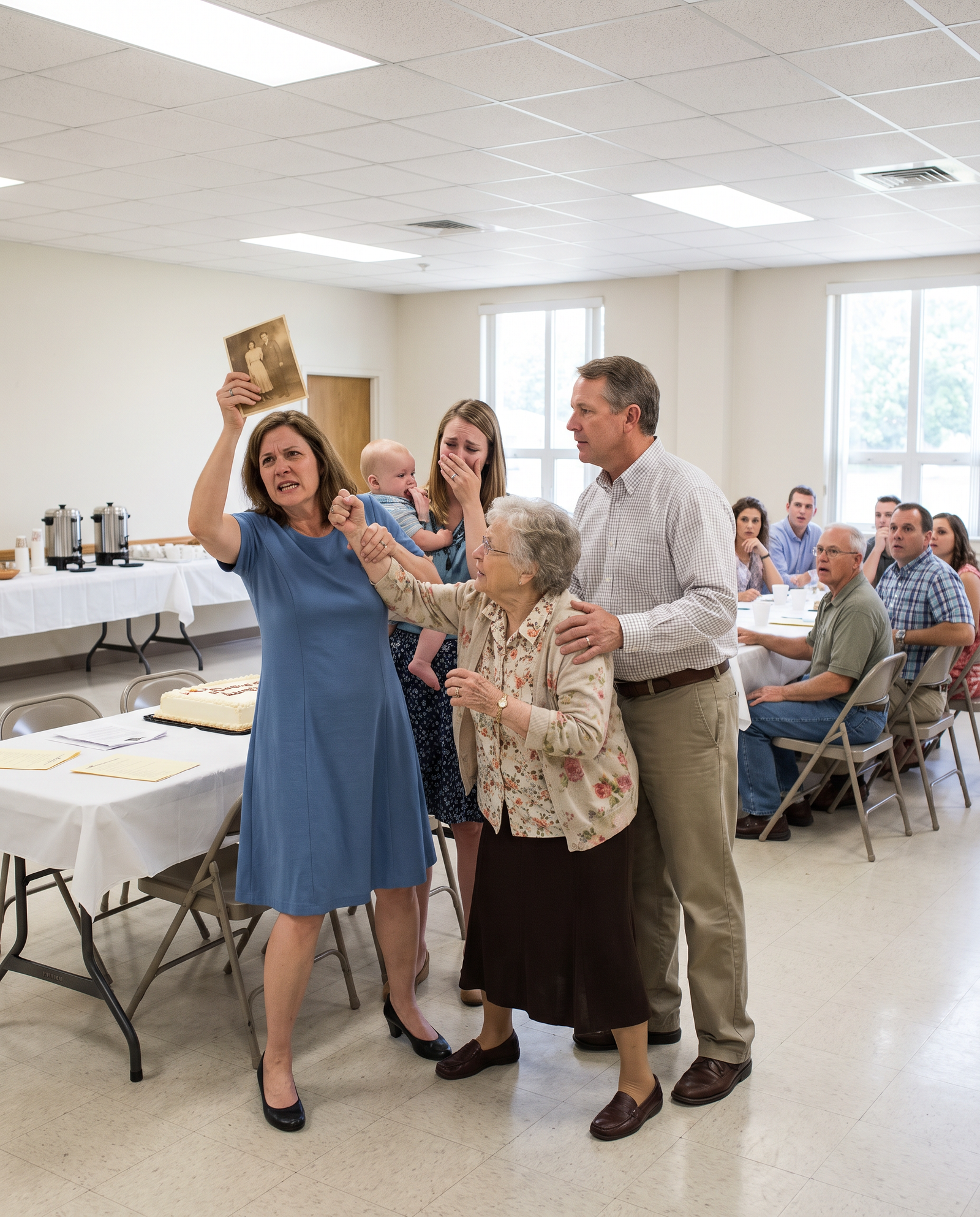
Bree’s daughter was baptized on a Sunday morning in September at the same church where we’d held my father’s funeral, which I don’t think anybody but me found strange until about eleven minutes into the reception in the fellowship hall.
Sixty people. Coffee urns, a sheet cake, my mother holding court by the folding tables the way she always does, telling the pastor’s wife about her hip.
I’d brought a manila envelope.
Bree knew. I’d told her three weeks earlier, in her kitchen, and she’d cried for forty minutes and then said, very calmly, “Do it where she can’t lie about it afterward.”
I set the envelope on the table next to the cake.
“Mom,” I said. “I need to ask you something in front of everybody.”
The room didn’t go silent right away. It went silent in pieces, table by table, the way a room does when people realize something is happening.
“Nina, sit down.”
“Where is Dad buried?”
She laughed, one short sound with nothing behind it. “You know where your father is buried.”
“Riverside Memorial, plot 40-C.” I opened the envelope and took out the driver’s license, the tax documents, and one photograph, a picture of my father at a kitchen table in Tacoma in 2017, wearing a paper birthday hat. “Then explain this.”
She reached for the photograph and I moved it out of her reach. She grabbed my wrist instead, hard enough that her nails caught, and for one second we were both just standing there holding onto each other in front of my niece’s baptism cake, my mother’s grip white-knuckled around my arm and my other hand holding a photo of a dead man’s sixty-fifth birthday.
My uncle Dale stood up from his table and got between us, one hand on my mother’s shoulder, easing her back.
“Deb,” he said. “Let go of her.”
She did.
“He left,” she said. Loud. To the whole room, because she’d decided in that half second that she was going to get out in front of it. “He left, and I was not going to let this family be the family whose father walked out, so I gave you all something you could grieve instead of something you’d have to be ashamed of.”
Bree was crying at the next table with her four-month-old on her shoulder.
“You buried a box,” I said.
“I gave you a story you could live with.”
“You gave him a story he could live with. You wrote him letters for eleven years, Mom. You kept the story straight so nobody would find him. You didn’t protect us from anything. You covered for him.”
Nobody in that hall said a word.
My mother looked around at sixty people, at the pastor, at her sister, at the two nieces she’d told for over a decade that their brother-in-law died in a car accident on Highway 195, and I watched her understand that there was no version of the next five minutes where she came out of it intact.
She left through the side door and didn’t come back.
PART 5
Robert Ellis died in April 2022, sixteen months before I ever bid on that storage unit. Heart failure, in a hospital in Tacoma, with a woman named Carol Ellis listed as his spouse and two adult children listed as next of kin. The unit went into default when the automatic payments stopped.
He’d been married to Carol since 2010, which made it bigamy, since he’d never actually divorced my mother.
I met Carol once, in a coffee shop in Puyallup, four months after the baptism. She was sixty-one and she brought a folder of her own, because she’d started pulling threads the day I first called her.
She hadn’t known any of it. He’d told her he was widowed. He’d told his own two kids that their half-sisters in Spokane had cut him off years ago.
“He cried at his own funeral,” she said at one point, and then had to explain that she meant a story he told, about attending a memorial for an old friend. She got very quiet after she said it out loud.
We didn’t become family. That would be a tidier ending than what actually happened. But we email a few times a year, and last spring she sent me a box of photographs from before 2007, ones he’d taken with him, including one of me at eight years old holding a fish I was terrified of.
My mother and I haven’t spoken in two years. Bree talks to her occasionally, which I’ve stopped having opinions about, because grief and anger don’t move at the same speed in two people and I’m not going to ask my sister to run at mine.
Riverside Memorial let us remove the marker from plot 40-C once we filed the paperwork with a copy of the actual death certificate. It cost four hundred and twelve dollars and took nine weeks.
I kept the photo albums. All of them. They sit on the bottom shelf in my hallway, a decade of a family I wasn’t in, and sometimes I take one down and look at his hands, at that white curved scar, and I think about the six-year-old in the back seat with the dish towel.
He was there for that. That part was real. Whatever else he was, he was there for that.
Some men don’t die. They just decide which people get to keep them.