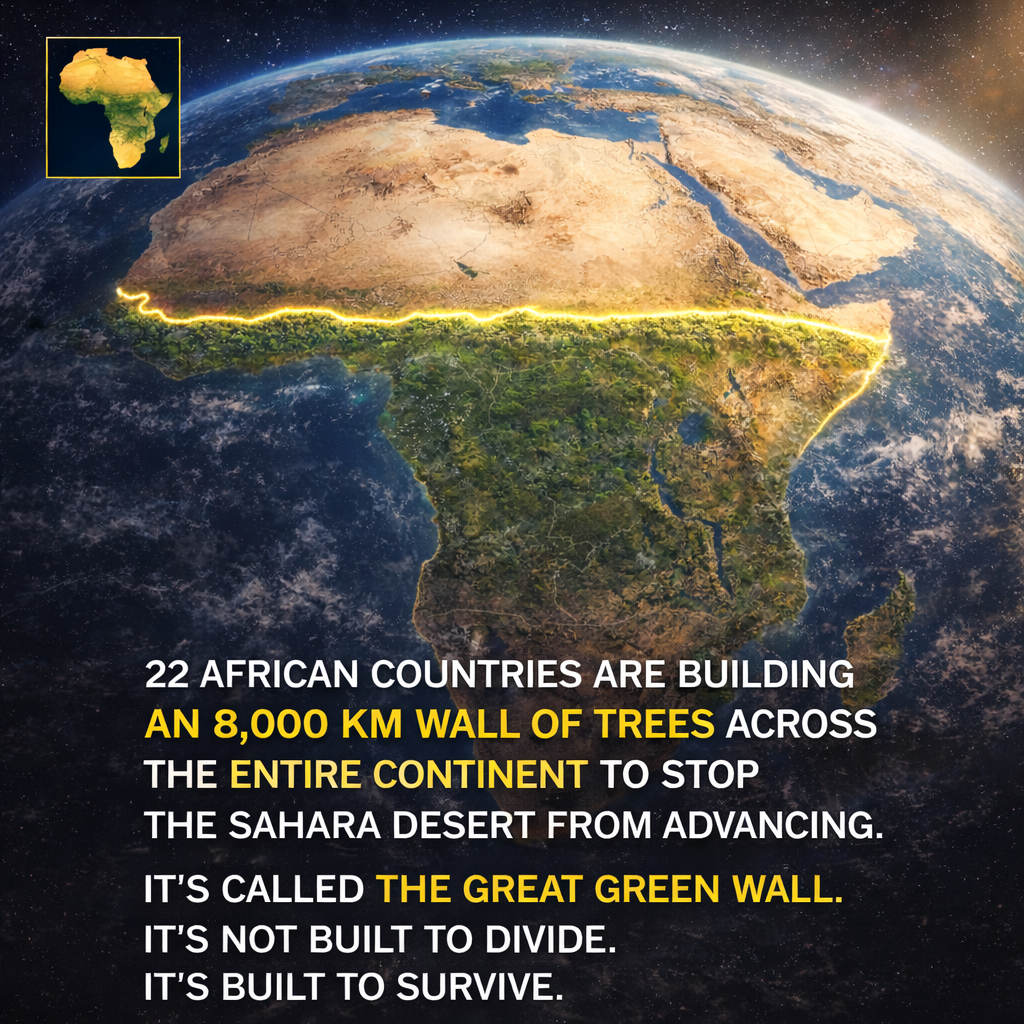
The idea of building a “wall of trees” across an entire continent sounds almost mythical—but in Africa, it’s very real. Known as the Great Green Wall, this ambitious initiative stretches roughly 8,000 kilometers from Senegal in the west to Djibouti in the east, cutting across the southern edge of the Sahara Desert. What began in 2007 as a bold vision by the African Union has grown into one of the largest ecological restoration projects ever attempted.
At its core, the Great Green Wall aims to combat desertification—the gradual expansion of deserts into fertile land—by restoring degraded ecosystems across the Sahel region. This semi-arid belt of land, which runs just south of the Sahara, is home to millions of people who depend on farming and livestock for survival. As climate change intensifies droughts and land degradation, the stakes have become even higher.
The project’s goals are both environmental and economic. By 2030, organizers hope to restore 100 million hectares of degraded land, capture 250 million tons of carbon dioxide, and create 10 million jobs. These targets highlight that the initiative is not just about planting trees—it’s about building sustainable livelihoods and strengthening communities.
So far, progress has been meaningful but uneven. Around 18 million hectares of land have been restored, and millions of jobs have been created. Countries like Ethiopia have taken significant steps, planting billions of seedlings as part of national reforestation campaigns. Meanwhile, Nigeria has restored millions of hectares through a mix of tree planting and improved land management techniques. These efforts show that large-scale environmental recovery is possible when governments and communities work together.
Funding has also played a critical role. International donors have pledged more than $14 billion to support the project, recognizing its global importance in the fight against climate change. However, experts caution that not all of this funding has reached local communities where it is needed most. Delays in implementation, administrative challenges, and limited infrastructure have slowed progress in some areas.
Another major challenge lies in the survival rate of newly planted trees. In harsh climates with limited rainfall, young trees often struggle to take root. This has led to a shift in strategy. Instead of focusing solely on planting trees, the project has evolved into a broader approach that includes restoring natural vegetation, improving soil health, and supporting sustainable agriculture. In many places, farmers are now using traditional techniques to regenerate trees naturally from existing root systems, which has proven more effective and resilient.
Conflict and instability have also posed serious obstacles. Regions in countries like Mali and Chad face security challenges that make it difficult to carry out long-term environmental projects. Despite these difficulties, local communities continue to play a vital role, often leading restoration efforts on the ground.
Perhaps the most important aspect of the Great Green Wall is its impact on people. Beyond environmental benefits, the project helps secure food supplies, increase water availability, and provide income opportunities. By restoring the land, it offers hope to millions who might otherwise be forced to migrate due to failing crops and shrinking resources.
The Great Green Wall is no longer just a line of trees—it is a living, evolving system of farmland, grassland, and forests. It represents a new way of thinking about environmental restoration, one that combines science, tradition, and community action.
While the project is still far from complete, its progress demonstrates what is possible when nations unite around a common goal. In a world facing growing climate challenges, the Great Green Wall stands as a powerful example of resilience, cooperation, and long-term vision.