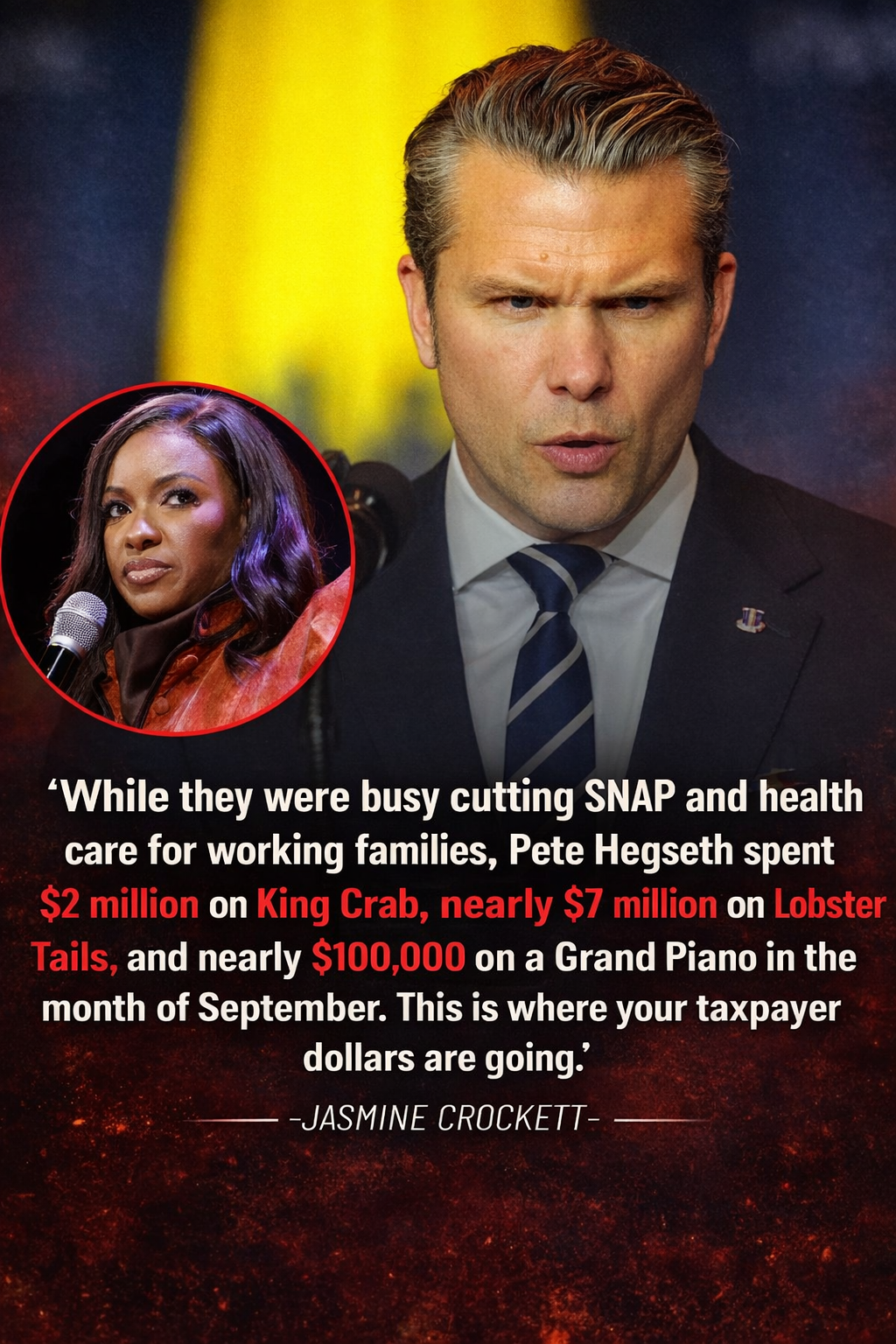
The $93 Billion Spending Spree: Why Lobster, King Crab, and a Grand Piano Sparked a National Debate
In Washington, debates over government spending are nothing new. But every once in a while, a set of numbers surfaces that ignites public outrage almost instantly. That is exactly what happened after new reports revealed how the U.S. Department of Defense spent billions of dollars during the final month of the 2025 fiscal year.
At the center of the controversy is Defense Secretary Pete Hegseth and a wave of criticism from politicians such as Representative Jasmine Crockett, who questioned whether the government’s priorities truly match its promises to taxpayers.
The numbers behind the debate are startling—and they have quickly spread across social media.
The Spending That Triggered the Controversy
According to an analysis by the government watchdog group Open the Books, the Pentagon obligated $93.4 billion in grants and contracts in September 2025, the final month of the federal fiscal year.
While the Defense Department regularly increases spending at the end of the fiscal year, the scale of this spending spike was unusually large. Critics quickly highlighted several purchases that appeared extravagant to many Americans, including:
$2 million on Alaskan king crab
About $6.9 million on lobster tails
$15.1 million on ribeye steak
$124,000 on ice-cream machines
Nearly $100,000 for a Steinway grand piano
Over $139,000 on donut orders
These purchases were part of a broader surge of contracts that occurred in the final days of the fiscal year. In fact, roughly $50 billion of the total spending happened in just the last five working days of September.
For critics, those numbers raised a simple but powerful question: Is this really how taxpayer money should be used?
Jasmine Crockett’s Criticism Goes Viral
Representative Jasmine Crockett, a Democrat from Texas, publicly criticized the spending during a broader discussion about federal budget priorities.
She argued that while lawmakers debate cuts to programs such as food assistance and healthcare support for working families, millions of dollars were being spent on luxury food items and high-end purchases.
Her remarks quickly spread online, with many people echoing her message that taxpayers deserve clearer explanations for how government money is spent.
Crockett’s criticism tapped into a deeper frustration that has existed in American politics for years: the perception that everyday families are asked to tighten their budgets while government agencies continue to spend freely.
Why the Pentagon Spends More at the End of the Year
Supporters of the Defense Department say the story is more complicated than it appears.
The spike in spending is partly tied to a long-standing federal budget rule often referred to as “use-it-or-lose-it.”
Under this system, government agencies must spend their allocated budget before the fiscal year ends. If they fail to do so, Congress may reduce their funding the following year.
Because of this rule, agencies—including the Pentagon—often rush to finalize contracts in September. Watchdog groups say this pattern has existed for decades and occurs under both Democratic and Republican administrations.
In other words, the spending itself is not entirely unusual. What is unusual is how large the totals were in 2025.
Critics Say the System Encourages Waste
Even if the spending is technically allowed, critics argue that the system itself encourages waste.
The idea that millions of dollars can be spent on seafood, furniture, and luxury items in a matter of days has fueled calls for reforms to the federal budgeting process.
Some lawmakers argue that the government should be able to roll over unused funds into the next year, rather than forcing agencies to spend everything quickly.
Without changes, critics warn that the same pattern will repeat year after year.
Supporters Say the Story Is Being Misinterpreted
Defenders of the Pentagon’s spending say some of the criticism may oversimplify the situation.
For example, large food purchases such as seafood or steak may be distributed across military bases, ships, and large troop populations. The military feeds millions of service members worldwide, and food procurement contracts can involve massive quantities.
Similarly, the grand piano purchase—while eye-catching—was reportedly intended for official military housing connected to senior leadership.
Supporters argue that when these expenses are viewed within the Pentagon’s enormous $800+ billion annual budget, they represent only a tiny fraction of total defense spending.
Still, optics matter—and that is where the controversy continues to grow.
A Larger Debate About Government Priorities
Ultimately, the debate is not just about seafood or a piano.
It is about trust.
For many Americans, government spending decisions feel distant and difficult to understand. When headlines highlight expensive purchases, they reinforce the belief that taxpayer money is not always handled responsibly.
That is why the story has gained so much traction online.
It taps into a universal question people across the political spectrum ask:
Are our tax dollars being spent wisely?
Why Stories Like This Go Viral
Stories about government spending often go viral because they combine three powerful elements:
Large numbers that capture attention
Relatable frustration about taxes and cost of living
A simple narrative about fairness
Whether people agree with Crockett’s criticism or believe the Pentagon’s spending has been misrepresented, the debate highlights something important: Americans want transparency.
And in an era where every government decision is instantly dissected online, that demand for accountability is only growing.