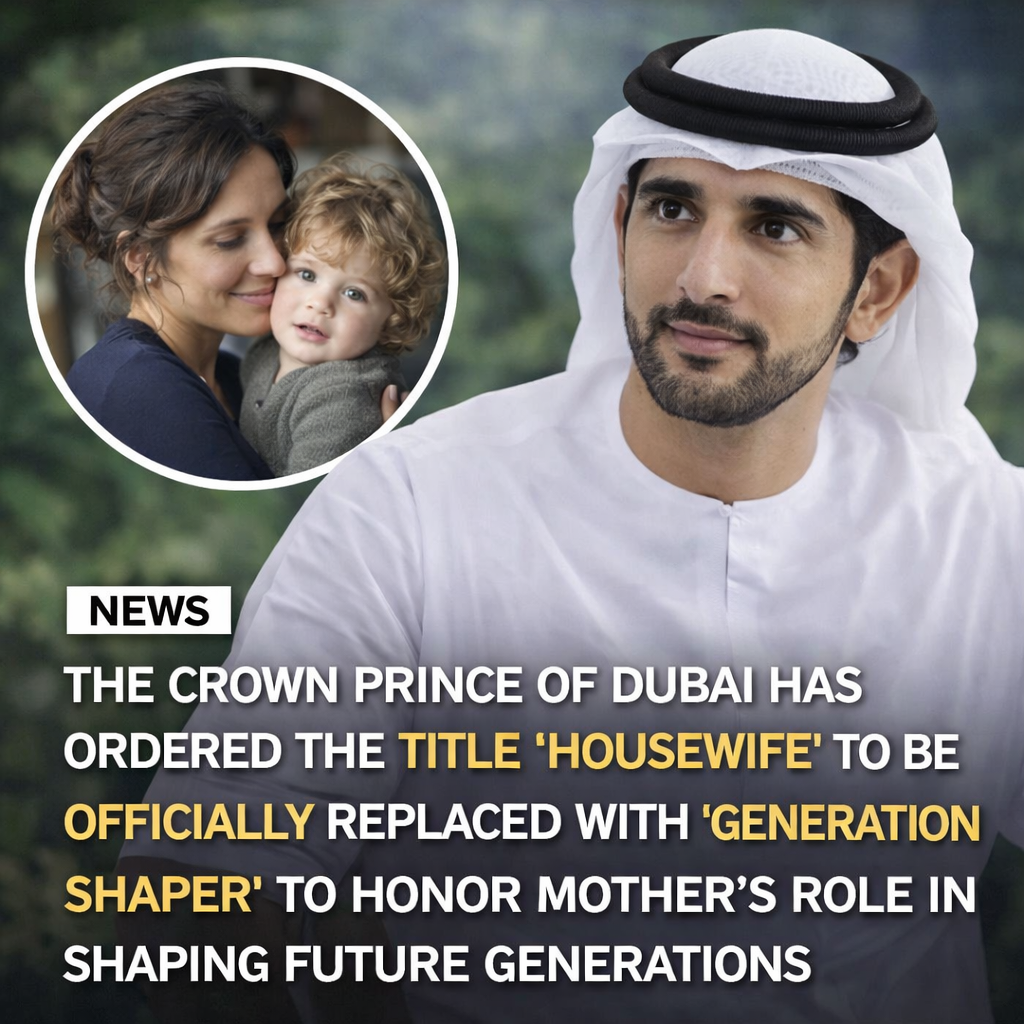
In a move that has sparked widespread discussion, Dubai has taken a significant step toward recognizing the societal role of mothers in a more meaningful way. Rather than continuing the long-standing debate about whether stay-at-home mothers deserve greater respect, the emirate has chosen to formalize that recognition through policy.
On March 21, 2026, Sheikh Hamdan bin Mohammed Al Maktoum announced that the term “housewife” would be officially replaced with “Generation Shaper” across all government documents in the United Arab Emirates. The directive was issued to the Community Development Authority on the occasion of Mother’s Day, emphasizing the symbolic importance of the announcement.
This change is not merely cosmetic. It applies to a wide range of official records, including Emirates identification cards, healthcare documents, and school-related paperwork. By embedding the new title into administrative systems, Dubai is institutionalizing a shift in how motherhood is perceived and valued.
According to Sheikh Hamdan, the term “housewife” fails to capture the depth and importance of a mother’s role. He stated that mothers serve as the first school for their children, where lessons about belonging, responsibility, and values are first introduced. In his view, the traditional label focuses only on a woman’s location—her home—rather than the impact of her work.
The newly adopted term, “Generation Shaper,” reflects a broader understanding of motherhood. It highlights the role of mothers in raising children, instilling values, and contributing to the long-term development of society. By reframing the language, the initiative aims to align terminology with the actual influence mothers have on future generations.
This is not the first time Dubai has introduced changes to official language in order to reflect social values. In 2017, Sheikh Mohammed bin Rashid Al Maktoum directed that the phrase “people with disabilities” be replaced with “People of Determination” in all government communications. That move was widely seen as an effort to promote dignity, inclusion, and a more empowering narrative.
The latest update follows a similar philosophy: language shapes perception. By choosing words that emphasize contribution and strength rather than limitation or simplicity, policymakers aim to influence how individuals and roles are viewed within society.
Public response to the “Generation Shaper” designation has largely been positive. Many observers have described the change as overdue, noting that the responsibilities of stay-at-home mothers often go unrecognized in formal and economic terms. Supporters argue that the new title acknowledges the intellectual, emotional, and social labor involved in raising children.
At the same time, the decision has also contributed to broader conversations about the role of language in shaping cultural attitudes. Titles used in official documents carry weight, influencing how roles are perceived both socially and institutionally. By redefining this terminology, Dubai is attempting to shift that perception in a more inclusive and appreciative direction.
While the policy does not directly alter economic structures or provide financial compensation, it represents a symbolic yet impactful step. Recognition at the institutional level can influence future discussions about social support, family policies, and gender roles.
Dubai’s decision highlights a growing awareness of the importance of unpaid work within households, particularly the role of mothers in shaping future generations. By moving beyond debate and implementing change through official channels, the emirate has set an example of how language can be used as a tool for social recognition.
In redefining “housewife” as “Generation Shaper,” Dubai is not just changing a label—it is reframing the narrative around motherhood itself.