Mara Higgins didn’t think much of it when the school called. Teachers called about lost mittens, about lice checks, about the science fair permission slip due Friday. She parked in the visitor lot and walked into Lincoln Elementary expecting five minutes and an apologetic smile.
Instead she found Mrs. Petrakis standing at her desk with her daughter’s backpack open on the table between them, and an expression on her face that made Mara’s stomach drop before either of them said a word.
“Sit down,” Mrs. Petrakis said. “Please.”
Inside the backpack, beneath the folders and the half-eaten granola bar, were things that didn’t belong to a six-year-old. A folded child’s sweater that wasn’t Lucy’s. A toothbrush, worn down to almost nothing. A single sock, adult-sized, tucked into the bottom seam like someone had hidden it there on purpose.
“I found these when I was helping her repack her folders on Monday,” Mrs. Petrakis said. “I didn’t think anything of the first two items. Kids collect strange things. But then on Wednesday there was this.”
She slid a folded piece of notebook paper across the desk. Mara opened it. It was Lucy’s handwriting, still shaky with kindergarten letters, but the words were clear enough to read twice.
don’t tell mommy james sleeps in the garage he says its our secret
Mara’s husband, Daniel, had been gone eleven days on what he called a work trip to Denver. She had talked to him twice by phone. He’d sounded tired both times. She had assumed it was the flight.
“Who is James?” Mrs. Petrakis asked gently.
“I don’t know anyone named James,” Mara said, and she meant it, and that was almost worse than a lie would have been.
She drove home faster than she should have. The garage door was down, same as always, same as it had been every day for eleven days while she parked in the driveway because Daniel always said the garage needed better shelving before she could fit her car in there too.
She lifted the door manually, the motor override sticking the way it always did, and stepped into a space she hadn’t actually walked into in months.
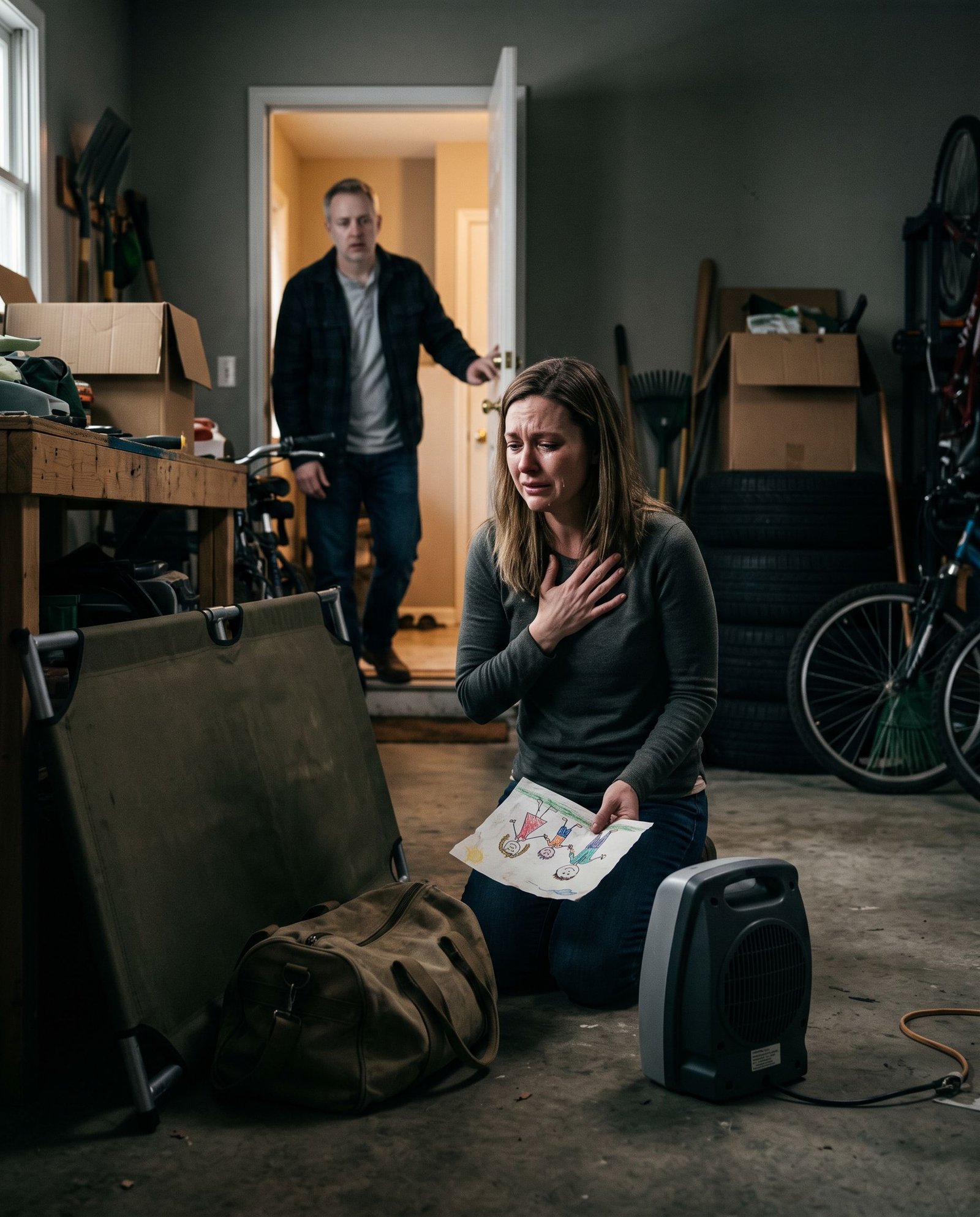
A cot was folded against the far wall behind the tool bench, the kind you’d buy for camping. A space heater sat coiled with its cord wrapped neatly. A duffel bag, unfamiliar, was tucked beside a stack of moving boxes that had been there since they bought the house three years ago.
And taped to the inside of the side door, at exactly the height a six-year-old would see it, was a child’s drawing. A stick figure family. Mara, Lucy, and a third figure, tall, drawn in gray crayon, labeled in Lucy’s handwriting: James.
Mara called Daniel that night before she called anyone else. She didn’t tell him what she’d found. She only asked him to come home a day early.
He arrived the next evening, and when she led him to the garage without a word, his face didn’t do what she expected. He didn’t look confused. He looked relieved, the way a person looks when a weight finally gets set down.
“His name is James Okafor,” Daniel said. “He’s my brother.”
Mara had never heard Daniel mention a brother in eleven years of marriage. She said as much, and Daniel sat down on the workbench stool like his legs had stopped agreeing to hold him up.
“Our mother separated us when I was nine,” he said. “Different foster placements. I didn’t find him again until eight months ago, a message on a genealogy site. He’s been in and out of shelters since he aged out of the system. I didn’t know how to tell you. I didn’t know how to explain a stranger who’s my blood but not my family, not yet, not in any way you’d recognize.”
“So you hid him in our garage.”
“I was going to tell you once I knew if he was staying. I didn’t want you to meet him and then have him disappear again. I’ve lost him twice already.”
Lucy, it turned out, had found James on her own three weeks earlier, wandering out to get her bike from the garage on a Saturday morning while Mara was at the grocery store. James had made her promise not to tell, not out of malice, but because he was as afraid of being sent away again as Daniel was of losing him.
Mara sat with all of it that night after Lucy was asleep: the fear that had lived in her own house for weeks without her knowing, the daughter who had carried a secret bigger than herself, the husband who had chosen silence because he didn’t trust her with the truth.
She didn’t call the police. She didn’t pack a bag. She sat across the kitchen table from a man she now understood she had never fully seen, and instead of a case, and asked him to bring his brother inside the house properly, through the front door, for dinner.
James moved into the spare room two weeks later, no longer a secret, no longer a stranger, still a stick figure in gray crayon on Lucy’s bedroom wall, except now the label under him just said uncle.