PART 1
My grandmother Vivian had lived at Cedar Hollow Assisted Living for two years when Priya started as her aide, and for the first four months I thought Priya was the best thing that had happened to that place.
She remembered that my grandmother liked her tea with exactly one sugar cube, not two. She brought in a portable CD player because my grandmother complained the facility’s speaker system made her hymns sound tinny. She sat with her during bingo even on days when bingo wasn’t part of her assigned shift.
I visited every Sunday. I’m a dental hygienist in Tulsa, thirty-four years old, and Sundays were the one day I could reliably drive the forty minutes out to Sand Springs without rearranging my whole week.
Around month five, I noticed my grandmother had started wearing long sleeves. All the time. Even in July, even inside a building that kept its thermostat at what felt like seventy-eight degrees for the residents who ran cold.
“Aren’t you hot in that?” I asked her once, nodding at a cream cardigan buttoned all the way to her wrist.
“Priya got it for me,” she said. “Isn’t it soft?”
It was soft. It was also the fourth long-sleeved item I’d seen her in over six weeks, and my grandmother had spent her whole life in short sleeves because she said long ones made her feel “boxed in.”
Priya was in the room both times I mentioned the heat, and both times she found a reason to adjust the cuff of whatever my grandmother was wearing, tugging it down over her wrist with a small, practiced motion, like straightening a collar.
“Vivian bruises so easily now,” Priya said the second time, smiling at me. “Blood thinners. We like to keep her covered up so she doesn’t scare herself looking at it.”
That was true. My grandmother had been on blood thinners since her hip surgery. It was a reasonable thing to say.
I believed it for another month.
PART 2
The Sunday it changed was hot, the kind of Oklahoma July where the parking lot shimmers, and my grandmother wanted to sit outside on the covered patio instead of in her room.
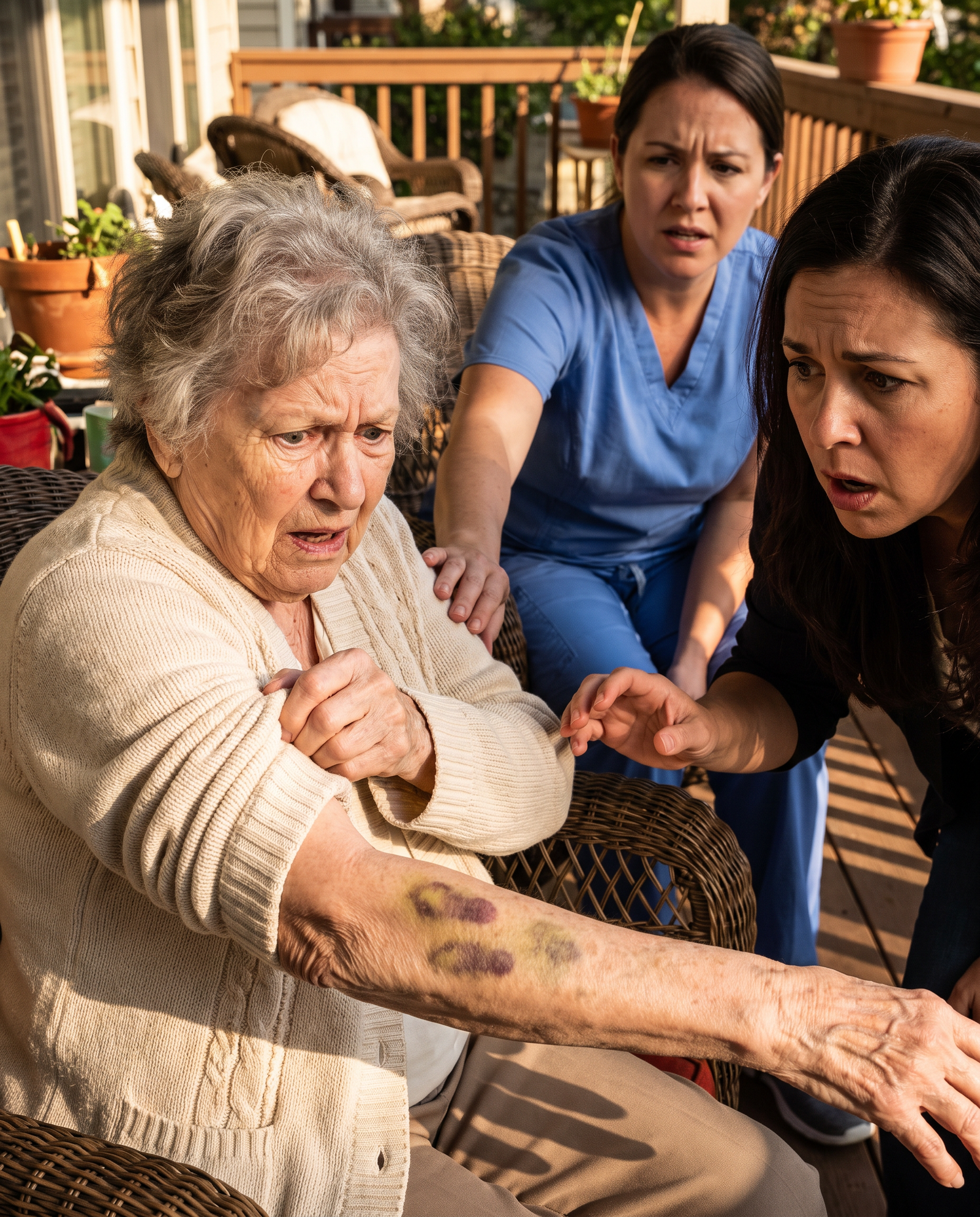
She was reaching for her water glass on the little wicker table when the cardigan sleeve slid up past her elbow.
I saw her forearm for maybe four seconds before she noticed and pulled the sleeve back down.
It wasn’t a bruise from a blood thinner. I know what those look like, faint yellow-green blooms from a rolled vein or a bumped edge. This was different. Two distinct oval marks, finger-width, dark purple going to green at the edges, positioned exactly where someone grips an arm hard enough to leave a print.
“Grandma.”
“It’s nothing.” She yanked the fabric down and picked up her water glass with her other hand.
“That’s not a blood thinner bruise.”
“Rosalind, don’t.”
She’d used my full name, which she only did when she wanted a conversation to end.
I didn’t push it that day. I’ve thought about that decision a hundred times since, whether pushing harder in that exact moment would have mattered, and I don’t think it would have. She wasn’t ready, and I didn’t yet have anything besides a look on her face and a mark on her arm.
What I did instead was start paying attention differently.
I started coming on Wednesdays too, unannounced, in addition to Sundays. I started asking the front desk casually about staff schedules, which shifts Priya worked. I started noticing that my grandmother had gone from having forty dollars in cash in her nightstand drawer, money she liked to keep for the ice cream cart that came around Thursdays, to having none at all, three separate times, replaced only after I mentioned it out loud to the facility director.
And I started noticing that every time I visited, for at least the first ten minutes, my grandmother’s eyes went to the doorway more than they went to me.
PART 3
I requested her financial statements from the facility’s resident trust account, the small fund they manage for residents who don’t handle their own banking day to day. As her documented emergency contact and healthcare proxy, I had the right to see them, though it took two phone calls and one visit to the administrator’s office before anyone actually produced them.
Over five months, the trust account had processed eleven cash withdrawals beyond my grandmother’s approved monthly allowance, each one requiring a staff witness signature. Priya Anand’s signature was on nine of the eleven.
Total: two thousand two hundred dollars.
My grandmother’s monthly Social Security and pension covered her care and left almost nothing extra. Two thousand two hundred dollars was not pocket change to her. It was, as it turned out, close to everything she had left outside her main accounts.
I still didn’t have the bruises explained. Withdrawal signatures don’t leave marks on skin.
The answer came from someone I hadn’t even thought to ask: Loretta, the resident three doors down, who used a walker and who my grandmother played cards with twice a week.
I found Loretta in the sunroom on a Wednesday and asked, carefully, if she’d ever noticed anything odd about Vivian and her aide.
Loretta didn’t hesitate.
“That girl grabs her,” she said. “Not soft. I’ve seen it twice, in the hallway, when Vivian’s walker gets going too slow for her liking. Grabs her right by the arm and yanks her along. Vivian never says anything after. I figured it wasn’t my business.”
I asked why she’d never told anyone.
“Who was I going to tell? The one time I mentioned it to the floor supervisor, she said Priya was one of their best aides and maybe I was confused about what I saw.”
PART 4
I filed a formal complaint with the Oklahoma Department of Human Services’ Adult Protective Services division, along with copies of the trust account statements and a written account from Loretta, who agreed to put her name on it once she understood I wasn’t going to let this disappear into a filing cabinet the way her first attempt had.
APS opened an investigation. So did the facility, once they understood a state agency was involved, though I noticed their internal review moved noticeably faster after that point than it had for the previous six weeks I’d been raising concerns informally.
My grandmother finally told me the rest of it herself, three days after the APS caseworker’s first visit, sitting on her bed with the cardigan finally off.
“She said if I told anyone about the money, she’d tell the facility I was getting confused, forgetting things, and they’d move me to the memory unit.” My grandmother’s voice was steady, which somehow made it worse. “I’ve seen the memory unit, Rosalind. I know what that would mean. So when she grabbed me, when she took the cash, I just went along.”
The bruises on her arm were from the two occasions Loretta had witnessed and at least one more my grandmother hadn’t mentioned to anyone, an incident where Priya had pulled her upright too hard and too fast after a fall in the bathroom, annoyed at how long the fall had taken to manage alone.
The confrontation didn’t happen in a dramatic hallway scene the way I might have imagined it three months earlier. It happened in a small conference room at the facility, with the administrator, an APS caseworker, my grandmother, and me on one side of the table, and Priya on the other, called in without being told exactly why.
She denied the bruises were from her. She said my grandmother “bruised if you looked at her wrong.” She stopped saying that the moment the caseworker set Loretta’s signed statement on the table, followed by the trust account withdrawal log with her own signature nine times over.
RESOLUTION
Priya Anand was terminated from Cedar Hollow that afternoon and reported to the state nursing aide registry board, which permanently revoked her certification eight months later following its own hearing. The Tulsa County District Attorney’s office charged her with financial exploitation of an elderly person and misdemeanor assault, and she pleaded guilty to both rather than face trial, receiving three years of probation and an order to repay the full two thousand two hundred dollars, which she completed in monthly installments over fourteen months.
Cedar Hollow’s corporate office conducted a facility-wide audit of trust account withdrawals after the case became part of the state’s public enforcement record, and two other residents’ accounts turned up smaller irregularities involving a different aide, who was also terminated.
My grandmother moved apartments within the facility, into a unit with a different care team, and started wearing short sleeves again by September. She still plays cards with Loretta twice a week. She still keeps forty dollars in her nightstand for the ice cream cart, and now the facility sends me a text notification every single time anyone touches that drawer.
I visit every Sunday and every Wednesday now, and I ask a lot more questions than I used to, out loud, in front of staff, without worrying about whether it’s polite.
My grandmother told me once, months later, that the worst part hadn’t been the money or even the bruises. It had been believing, for a little while, that keeping quiet was the only way to stay safe in her own home.
Nobody should ever have to make that trade.