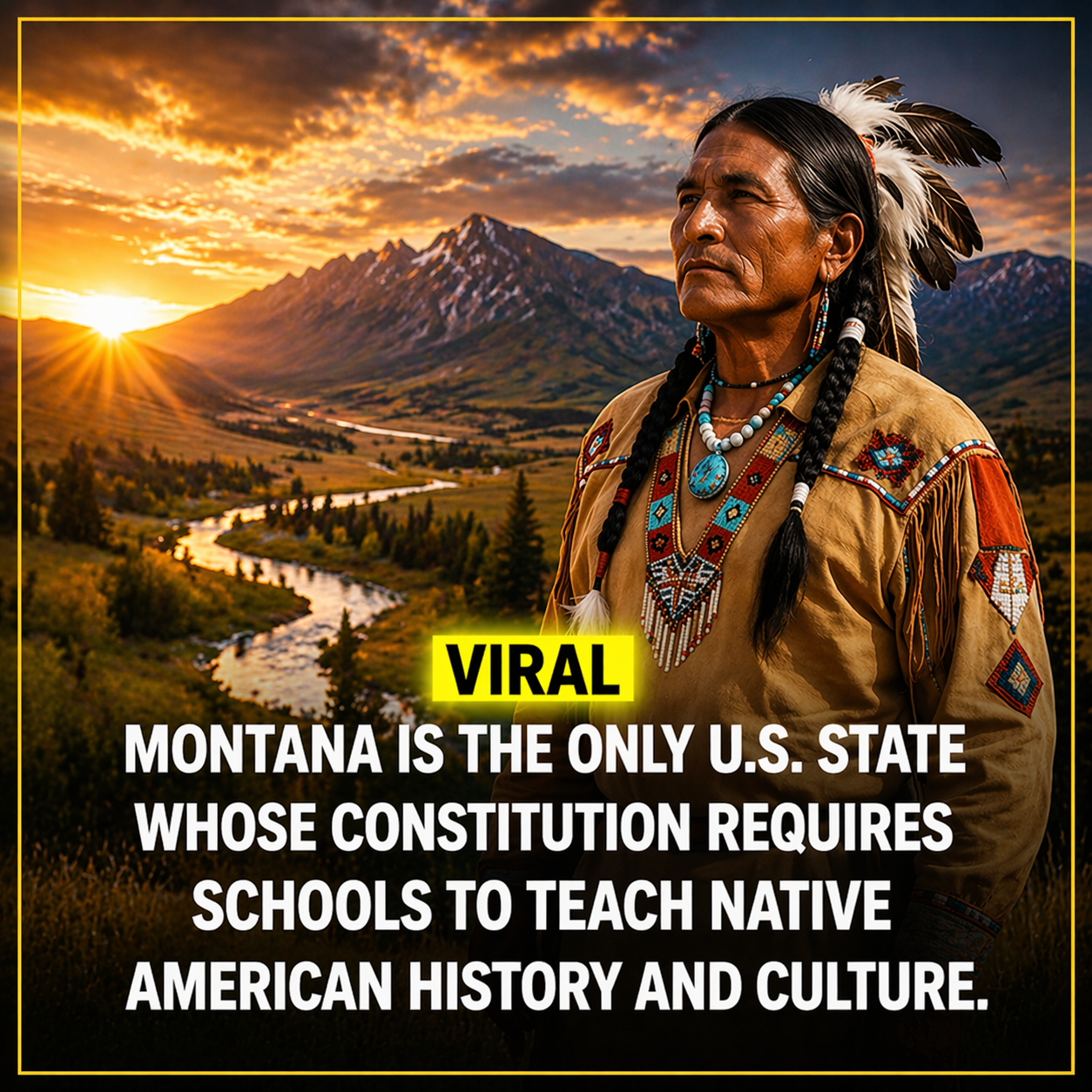
Most people assume that teaching Native American history in schools is a given across the United States. In reality, it often depends on individual districts, teachers, or optional programs. Only one state has taken a different path—embedding this responsibility directly into its constitution. That state is Montana, and it made that decision more than 50 years ago.
In 1972, Montana adopted a new constitution that included a powerful and forward-looking commitment. Under Article X, Section 1(2), the state formally recognized “the distinct and unique cultural heritage of the American Indians” and pledged to preserve that heritage through its educational goals. This wasn’t just symbolic language. It set a legal and moral standard that education in Montana should reflect the histories, traditions, and perspectives of Native communities in a meaningful way.
At the time, this was a remarkable step. Across much of the country, Native American history was either overlooked or reduced to brief, often inaccurate lessons focused on early colonial encounters. Indigenous voices were largely absent from textbooks, and students rarely learned about the complexity, resilience, and ongoing contributions of Native nations. Montana’s constitution challenged that pattern by placing Native heritage at the center of its educational mission.
The state built on this commitment in 1999 by passing the Indian Education for All Act. This law transformed constitutional intent into classroom reality. It requires that every public school student in Montana—regardless of background—learn about the history, culture, and contributions of American Indians. The goal is not only to educate Native students about their own heritage but also to ensure that non-Native students develop a deeper, more accurate understanding of the people who have long been part of the region’s identity.
One of the most important aspects of this approach is how the curriculum is developed. Rather than relying solely on standard textbooks or outside interpretations, schools work directly with Montana’s tribal communities. This collaboration ensures that lessons are grounded in authentic voices and lived experiences. It allows Native elders, educators, and cultural leaders to shape how their histories are told—bringing depth, accuracy, and respect to the material.
This model has had a meaningful impact. For Native students, seeing their culture and history represented in school can strengthen identity, pride, and a sense of belonging. For non-Native students, it offers a more complete and honest view of American history—one that goes beyond simplified narratives and acknowledges both challenges and contributions. It also helps build cultural understanding, which is essential in a diverse society.
Montana is home to several Native nations, including the Blackfeet Nation, Crow Nation, and Northern Cheyenne Tribe. Their histories are not distant or abstract—they are living, evolving stories that continue to shape the state today. By incorporating these perspectives into education, Montana acknowledges that Native culture is not just part of the past but an active and vital part of the present.
Despite its success, Montana’s approach remains unique. Most states do not have constitutional requirements or comprehensive laws mandating Native American education. While some have made progress in recent years, efforts are often inconsistent or limited in scope. This raises an important question: why hasn’t this model been adopted more widely?
Part of the answer lies in awareness. Many Americans simply don’t know that Montana has taken this step, or that such a model is even possible. Others may underestimate the importance of inclusive education or assume that existing curricula are already sufficient. But as Montana’s example shows, meaningful change requires intentional policy, collaboration, and a willingness to rethink how history is taught.
More than five decades after its constitutional commitment, Montana continues to stand alone in this space. Its approach demonstrates that education can do more than pass along information—it can preserve culture, correct historical gaps, and foster mutual understanding. In a country still grappling with how to tell its full story, Montana offers a practical and powerful example of what it looks like to get closer to the truth.