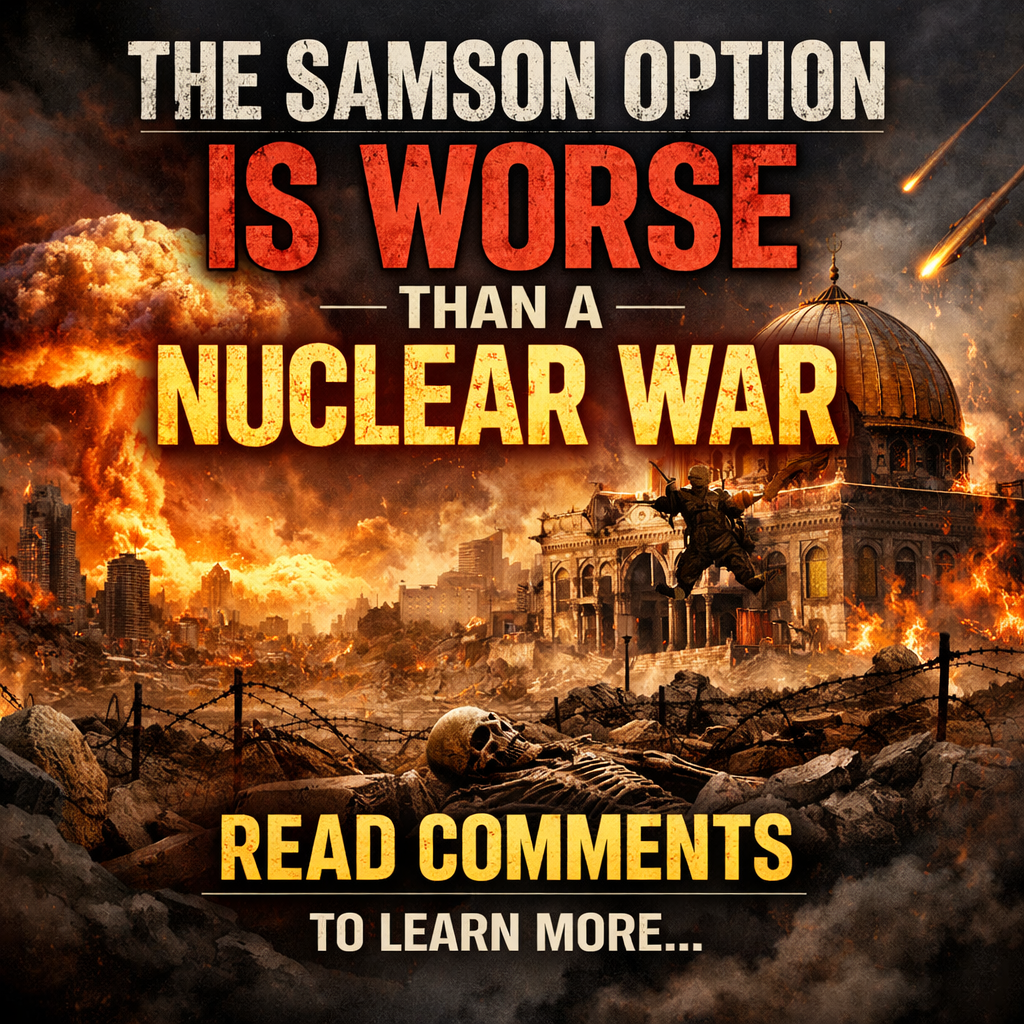
The phrase “Samson Option is worse than a nuclear war” sounds dramatic, even apocalyptic—and that’s because it refers to one of the most extreme strategic doctrines ever discussed in modern geopolitics. While nuclear war itself represents unimaginable destruction, the idea behind the Samson Option suggests something even more chilling: a last-resort scenario where destruction is not just defensive, but total.
So what does it actually mean?
The term “Samson Option” is believed to originate from the biblical story of Samson, who, when captured by his enemies, brought down a temple upon himself and his captors—choosing mutual destruction rather than defeat. In geopolitical terms, the Samson Option refers to a hypothetical military strategy where a nation, facing existential threat or total collapse, would unleash its full nuclear arsenal not only on its direct enemies but potentially on a wide range of targets across the globe.
Unlike traditional nuclear deterrence—which is based on preventing war through the threat of retaliation—the Samson Option goes a step further. It implies that if a nation cannot survive, it will ensure that its enemies—and possibly much of the world—do not survive either. This transforms the concept from deterrence into a doctrine of absolute finality.
Why is it considered worse than nuclear war?
In a typical nuclear conflict, even at its worst, the goal is often still tied to military advantage, retaliation, or survival. As horrifying as that is, there are still strategic limits, targets, and objectives. But the Samson Option removes those limits. It represents a mindset where restraint no longer matters, and the scale of destruction could extend far beyond immediate conflict zones.
The fear is not just about the number of weapons used, but the intent behind them. A controlled (though devastating) nuclear exchange could still leave parts of the world intact. The Samson Option, however, introduces the possibility of a global catastrophe—one that could trigger widespread environmental collapse, nuclear winter, and long-term consequences for all of humanity.
Another reason this concept is so unsettling is its unpredictability. It is not a publicly declared policy in most cases, but rather a strategic assumption discussed by analysts and historians. That ambiguity makes it even more dangerous. If such a doctrine exists in the background, it changes how nations perceive risk, escalation, and conflict.
It’s important to understand that discussions around the Samson Option are largely theoretical and analytical. They are used by experts to explore worst-case scenarios and to emphasize the importance of diplomacy, de-escalation, and international cooperation. The idea itself serves as a warning—a reminder of how far things could go if global tensions spiral out of control.
In today’s interconnected world, the consequences of any large-scale conflict would not remain contained. Economic systems, climate stability, food supplies, and human survival are all deeply linked. The Samson Option represents the breaking point of that system—the moment where destruction becomes indiscriminate and irreversible.
This is why many experts stress the importance of communication, treaties, and global dialogue. Preventing such extreme outcomes requires constant effort, trust-building, and a shared commitment to avoiding escalation.
The phrase “Samson Option is worse than a nuclear war” is not just a statement—it’s a warning. It forces us to confront the darkest possibilities of human conflict and recognize the urgent need to prevent them.